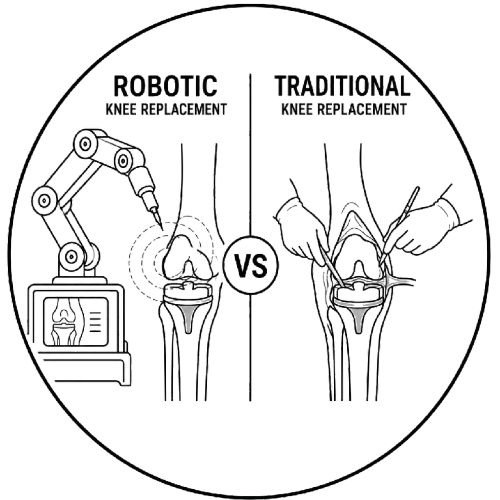
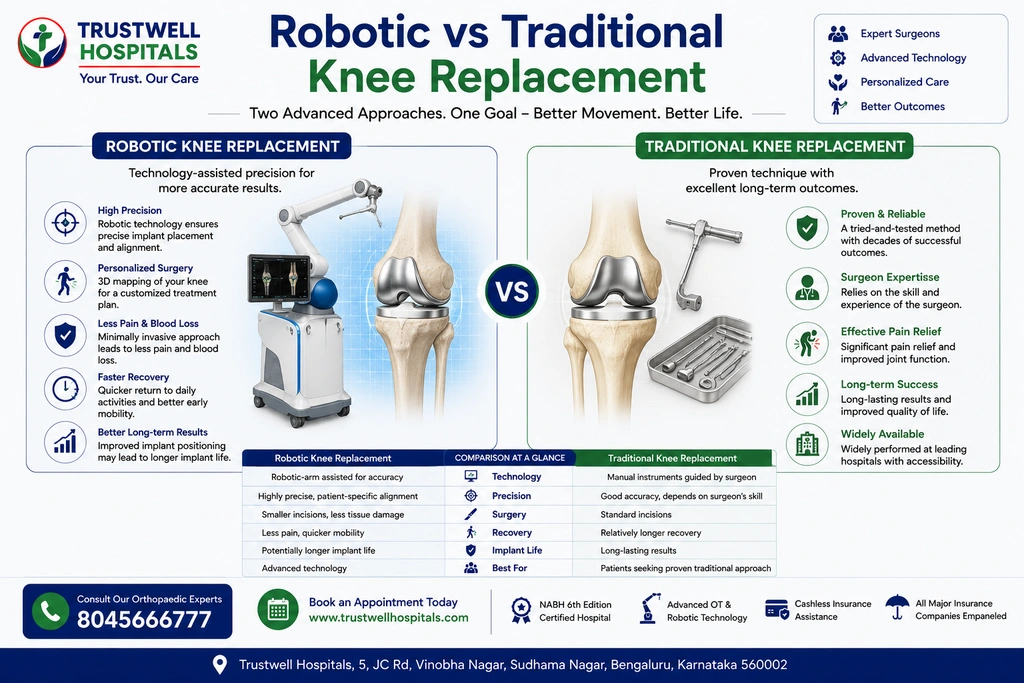
Why Choose Trustwell Hospitals for Robotic or Traditional Knee Replacement?
Patients comparing procedures often focus on differences between them, but successful treatment also depends on diagnosis, planning, surgical expertise, and rehabilitation. Access to both approaches allows treatment decisions to be guided by patient requirements rather than a single technique.
Experience Across Different Arthritis Patterns
Trustwell Hospitals has treated more than 10,000+ orthopaedic patients, including patients with advanced arthritis, deformities, and failed previous procedures requiring specialised treatment planning.
Precision-Guided Treatment Planning
With more than 1,500 joint replacement procedures performed, imaging findings and clinical assessment help determine the most appropriate surgical approach for each patient.
Evidence-Based Outcomes
Published studies have reported favourable outcomes with both robotic-assisted and conventional knee replacement when used in appropriately selected patients. Individual outcomes vary.
Access to Multiple Treatment Options
Patients have access to conventional and robotic-assisted procedures, allowing treatment strategies to be individualised. Those interested in broader orthopaedic procedures may also explore joint replacement treatment in Bangalore.
Trusted Orthopaedic Care
The department has provided more than 10,000 orthopaedic consultations, supported by patient satisfaction scores exceeding 95%.
Long-Term Follow-Up Support
Recovery programmes, physiotherapy, and regular follow-up visits help support mobility and implant function after surgery.
Meet Our Orthopaedic Specialists
The orthopaedic team at Trustwell Hospitals manages arthritis, fractures, sports injuries, trauma, and complex joint disorders, helping patients regain mobility and improve their quality of life.
Dr Ananya Puttaraju – Senior Consultant & HOD – Orthopaedics
Qualifications: MBBS, MRCS, FRCS (Tr & Ortho), CCBST – UK, Fellowship in Robotic Joint Replacement & Foot and Ankle Surgery
Experience: 20+ Years
Areas of Expertise
→ Robotic Knee Replacement Surgery
→ Hip Replacement Surgery
→ Revision Joint Replacement Surgery
→ Foot and Ankle Surgery
→ Complex Arthritis Management
→ Sports Injury Treatment
→ Trauma and Fracture Care
Dr Aditya H Kumar – Associate Consultant Orthopaedic Surgeon
Qualifications: MBBS, MS (Orthopaedics), Fellowship in Limb Reconstruction, Fellowship in Arthroscopy & Arthroplasty
Experience: 8+ Years
Areas of Expertise
→ Joint Replacement Surgery
→ Arthroscopy Procedures
→ Sports Injury Management
→ Knee and Shoulder Disorders
→ Trauma and Fracture Care
→ Limb Reconstruction
Dr Pavan Kumar G – Consultant Orthopaedic Surgeon
Qualifications: MBBS, MS (Orthopaedics)
Experience: 10+ Years
Areas of Expertise
→ Hip Replacement Surgery
→ Polytrauma and Accident Care
→ Fracture Management
→ Spine Disorders
→ Shoulder Conditions
→ Joint Preservation Procedures
What Do Patients Say About Knee Replacement at Trustwell Hospitals?
4.3 out of 5 from 2,000+ verified Google reviews
★★★★★
“The doctor explained both robotic and conventional surgery clearly and helped us choose the option that suited my father’s condition. Recovery support was excellent.”
Source: GBP
★★★★★
“We appreciated that the team focused on what was appropriate for the patient rather than promoting one technique over another.”
Source: GBP
★★★★★
“The consultation was detailed, and the expected recovery process was explained very clearly.”
Source: GBP
Is Trustwell Hospitals Accredited and Recognised for Orthopaedic Care?
Trustwell Hospitals follows recognised standards of patient safety and quality care.
NABH Accreditation
NABH accreditation reflects adherence to established standards relating to patient safety, quality, and clinical governance.
Awards and Recognition
Trustwell Hospitals has received recognitions for healthcare excellence and patient care initiatives.
Where Is Trustwell Hospitals Located and When Can You Visit?
Trustwell Hospitals is located in central Bengaluru and provides orthopaedic consultations throughout the week.
Hospital Information
Address: 5, JC Rd, Vinobha Nagar, Sudhama Nagar, Bengaluru, Karnataka 560002
Phone: 80 4566 6777
OPD Hours: 10:00 AM to 4:00 PM
Parking Facilities: Available
Nearby Transportation and Landmarks
→ Bengaluru City Railway Station (KSR Bengaluru): Approximately 4–5 km away, easily accessible by taxi, auto-rickshaw, and metro.
→ Kempegowda Bus Station (Majestic): Approximately 4–5 km away and connected to different parts of Bengaluru and nearby cities.
→ Kempegowda International Airport: Approximately 35–40 km away with cab and airport shuttle services available.
→ Lalbagh Metro Station: Approximately 2–3 km away and conveniently connected through Namma Metro.
→ Cubbon Park Metro Station: Approximately 3–4 km away and accessible from major residential and commercial areas.
→ Lalbagh Botanical Garden: Located nearby and serves as a well-known landmark for visitors.
→ Bengaluru Town Hall: Approximately 1–2 km away and easily identifiable for patients navigating to the hospital.
→ Victoria Hospital and BMCRI Campus: Situated in the vicinity, making the area familiar to many patients and caregivers.
Patients Visit Us From Nearby Areas
Patients regularly visit Trustwell Hospitals from Jayanagar (4–6 km), Basavanagudi (3–5 km), Richmond Town (2–4 km), Koramangala (5–8 km), Malleshwaram (6–8 km), Rajajinagar (7–9 km), Indiranagar (7–10 km), and surrounding areas across Bengaluru.
Frequently Asked Questions About Robotic vs Traditional Knee Replacement
Does robotic surgery replace the surgeon?
No. The surgeon remains in control throughout the operation. Robotic systems provide computer-assisted planning and guidance but do not perform the surgery independently.
Is robotic knee replacement more accurate?
Published studies suggest robotic systems may improve implant alignment and bone preparation in selected cases. However, individual outcomes depend on several factors, including surgical expertise and rehabilitation.
Is traditional knee replacement outdated?
No. Conventional knee replacement remains an established procedure with decades of clinical experience and continues to be performed successfully worldwide.
Does robotic surgery result in smaller scars?
The size of the incision depends on surgical technique and patient factors. Robotic assistance does not necessarily mean smaller scars.
Which procedure offers faster recovery?
Recovery timelines vary between individuals. Factors such as age, overall health, physiotherapy participation, and the severity of arthritis influence recovery more than the surgical approach alone.
Is robotic surgery suitable for everyone?
No. Treatment recommendations depend on imaging findings, knee alignment, and clinical assessment. Many patients continue to achieve excellent results with conventional surgery.
Are the implants different in robotic and traditional knee replacement?
In many cases, similar implant systems can be used. The difference lies primarily in the planning and positioning techniques rather than the implant itself.
Does robotic surgery reduce complications?
Some studies have shown improved alignment with robotic systems, but no surgical technique can completely eliminate risks. Outcomes vary among patients.
Why does robotic surgery usually cost more?
Robotic-assisted procedures involve specialised equipment, software, and additional planning, which may increase overall treatment expenses.
Which procedure lasts longer?
Implant longevity depends on several factors, including body weight, activity levels, implant type, and rehabilitation. Both approaches are designed to provide long-term function.
How do doctors decide which approach is appropriate?
Orthopaedic specialists consider arthritis severity, alignment, imaging findings, overall health, and patient expectations before recommending a treatment strategy.
Are there alternatives to knee replacement surgery?
Yes. Medication, physiotherapy, injections, and lifestyle modifications may help selected patients. Surgery is generally considered when conservative measures no longer provide adequate relief.


 Neuro Sciences
 Gastro Sciences
 Kidney Diseases
 Orthopedics
 Transplantation
 ENT and Head-Neck Surgery
 Advanced Trauma Center
 Cardiology
 Interventional Pulmonology
 Hematology and Bone Marrow Transplant(BMT)
 Anesthesia
 Critical Care Excellence, Comprehensive Intensive Care Services in Bangalore
 Dental Surgery and Oral Implants
 Dermatology and Cosmetic Surgery
 Endocrinology and Diabetology
 Facial Plastic and Reconstructive Surgery
 Family Medicine
 Internal Medicine
 Microbiology
 Obstetrics and Gynaecology
 Oncology
 Ophthalmology
 Oral and Maxillofacial Surgery
 Pathology and Laboratory
 Pediatrics