A New Milestone: Successfully accredited with NABH 6th Edition – Redefining standards in healthcare quality and patient safety | Live vitals. Real-time data. Faster care. Trustwell Hospitals unveils Karnataka’s first 5G SMART ambulance |
Find a Doctor Book Online Appointment
ACL Surgery vs No Surgery

ACL Surgery vs No Surgery

ACL Surgery vs No Surgery

acl surgery vs no surgery

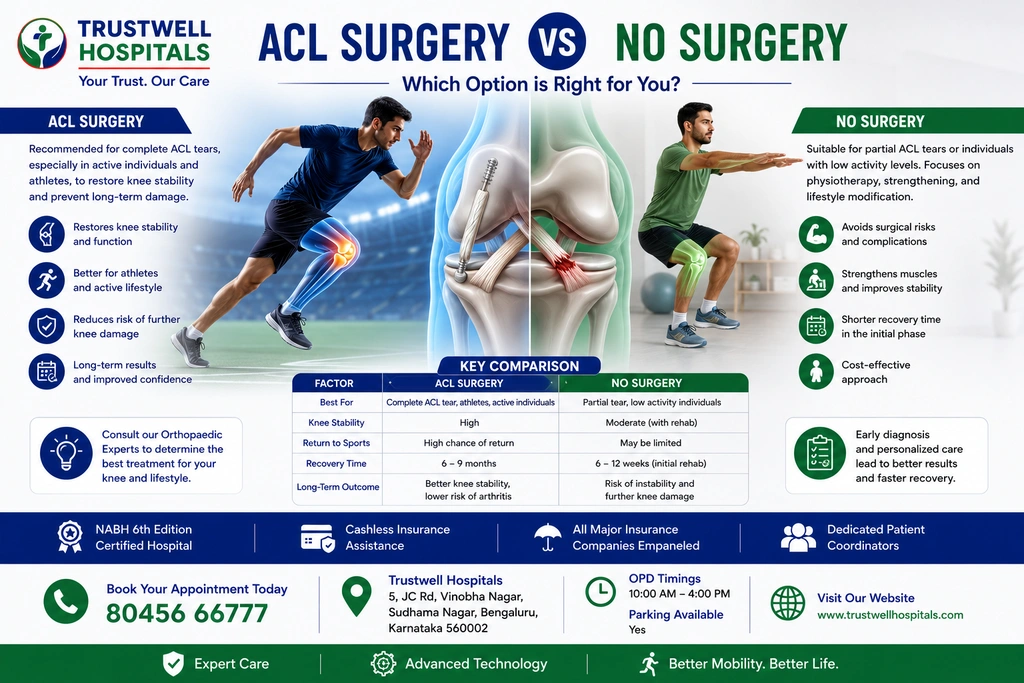
ACL Surgery and non-surgical treatment are two recognised approaches for managing an anterior cruciate ligament (ACL) injury. Surgery reconstructs the torn ligament, while non-surgical management focuses on rehabilitation, strengthening, and activity modification. The most appropriate option depends on the severity of the injury, knee stability, activity level, associated injuries, and individual goals. This guide explains both approaches to help you have a more informed discussion with your orthopaedic specialist.

How Do ACL Surgery and No Surgery Compare?

Parameter ACL Surgery No Surgery
Treatment Approach Arthroscopic ACL reconstruction Conservative (non-surgical) management
Primary Goal Restore ligament stability Improve knee function without reconstruction
Anaesthesia General or spinal anaesthesia Not required
Procedure Duration Approximately 1–2 hours No surgical procedure
Hospital Stay Usually 1–2 days Outpatient treatment
Recovery Progressive rehabilitation over several months Rehabilitation programme over weeks to months
Incision Small arthroscopic incisions No incision
Commonly Considered For Persistent instability, complete ACL tears, active individuals Stable knees, selected partial or complete tears, lower activity demands
The information above is indicative. Your orthopaedic specialist determines the most appropriate treatment after evaluating your symptoms, physical examination, MRI findings, lifestyle, and recovery goals.

What Is ACL Surgery?

ACL Surgery, commonly known as ACL Reconstruction, is a minimally invasive arthroscopic procedure performed to restore knee stability after an anterior cruciate ligament tear. Instead of repairing the torn ligament directly, the surgeon reconstructs it using a tendon graft obtained from the patient’s own tissue or a donor graft, depending on individual clinical circumstances. The procedure is performed through small incisions using an arthroscope, a specialised camera that allows the surgeon to reconstruct the ligament with minimal disruption to surrounding tissues. The objective is to improve knee stability while supporting a gradual return to everyday activities and, where appropriate, sports participation.

Advantages of ACL Surgery

✔ Improves Knee Stability

Reconstructing the ACL may help reduce episodes of the knee giving way during walking, running, pivoting, and other activities that place rotational stress on the joint.

✔ Supports Higher Activity Levels

Patients involved in competitive sports or physically demanding occupations may discuss surgery when greater knee stability is required for their daily activities.

✔ Addresses Associated Knee Injuries

If MRI or arthroscopic assessment identifies meniscus or cartilage damage, these conditions may also be managed during the same surgical procedure when clinically appropriate.

✔ Minimally Invasive Arthroscopic Technique

Most ACL reconstructions are performed using arthroscopy, which uses small incisions and specialised instruments to access the knee joint.

Limitations and Considerations

Rehabilitation Remains Essential

Surgery is only one part of treatment. A structured physiotherapy programme plays an important role in restoring movement, strength, balance, and function after reconstruction.

Recovery Takes Time

Although patients often begin walking early after surgery, returning to sports or demanding physical activities generally requires several months of supervised rehabilitation.

Surgery Is Not Required for Every ACL Tear

Not every ACL injury requires reconstruction. Some patients achieve satisfactory knee function through structured rehabilitation without surgery.

Treatment Is Individualised

MRI findings, knee stability, associated injuries, activity level, occupation, and personal goals all influence whether surgery is considered appropriate. Your orthopaedic specialist confirms whether ACL reconstruction is suitable after reviewing your examination findings and diagnostic imaging.

What Does No Surgery Mean for an ACL Tear?

Non-surgical management, often called conservative treatment, focuses on improving knee stability, strength, and function without reconstructing the torn ACL. Treatment usually combines physiotherapy, muscle strengthening, balance training, activity modification, and, when appropriate, supportive knee bracing. The goal is to help patients regain confidence in knee movement while improving functional performance for everyday activities. Rehabilitation programmes are personalised according to the severity of the injury, symptoms, lifestyle, and functional expectations.

Advantages of Non-Surgical Treatment

✔ No Surgical Procedure

Treatment avoids an operation and focuses on rehabilitation through structured physiotherapy and guided exercise programmes.

✔ Strengthens Supporting Muscles

Improving the strength of the quadriceps, hamstrings, and surrounding muscles helps provide additional support to the knee joint during movement.

✔ Individualised Rehabilitation

Exercise programmes are progressively adjusted according to recovery, allowing rehabilitation to match the patient’s symptoms and functional goals.

✔ Appropriate for Selected Patients

Patients with stable knees, lower physical demands, or partial ACL injuries may be considered for conservative treatment depending on their clinical assessment.

Limitations and Considerations

The Torn Ligament Is Not Reconstructed

Although rehabilitation can improve knee function, it does not replace or rebuild a completely torn ACL.

Instability May Persist in Some Patients

Certain individuals may continue to experience episodes of knee giving way, particularly during twisting or pivoting movements.

Activity Modifications May Be Required

Depending on knee stability and functional demands, some patients may need to modify participation in high-impact or pivoting sports.

Ongoing Assessment Is Important

Progress should be monitored regularly. If symptoms, instability, or functional limitations continue despite rehabilitation, further specialist evaluation may be recommended. The decision between surgery and non-surgical treatment is based on a detailed clinical assessment, MRI findings, activity level, and the patient’s individual recovery goals.

When Is ACL Surgery Typically Recommended?

Whether ACL reconstruction is appropriate depends on several clinical factors rather than the MRI scan alone. Your orthopaedic specialist evaluates knee stability, associated injuries, activity level, occupation, and long-term functional goals before recommending surgery.

ACL Surgery May Be Considered When

Persistent Knee Instability

Patients who experience repeated episodes of the knee giving way during walking, running, turning, or sporting activities may be evaluated for ACL reconstruction.

Return to Pivoting or Contact Sports Is Planned

Individuals planning to return to sports involving sudden changes in direction, jumping, or pivoting may discuss surgical treatment as one of the available options.

Complete ACL Tear With Functional Limitations

A complete ACL tear accompanied by ongoing instability despite rehabilitation may influence treatment planning.

Associated Meniscus or Cartilage Injuries

When MRI identifies additional knee injuries, ACL reconstruction may be considered alongside treatment of the affected structures where clinically appropriate.

Physically Demanding Occupation

Patients whose work involves climbing, squatting, heavy lifting, or frequent movement on uneven ground may require greater knee stability depending on their job responsibilities.

When ACL Surgery May Not Be Recommended

  • The knee remains stable during everyday activities.
  • Symptoms improve with structured rehabilitation.
  • Medical conditions require optimisation before surgery.
  • Activity demands do not require surgical reconstruction.
  • The patient prefers conservative treatment after discussing available options with the specialist.
The final recommendation is based on physical examination, MRI findings, lifestyle requirements, and individual treatment goals.

When Is Non-Surgical Treatment Typically Recommended?

Conservative management is considered for selected patients after evaluating knee stability, injury severity, activity level, and functional expectations. Rehabilitation programmes are tailored according to individual recovery goals.

Non-Surgical Treatment May Be Considered When

The Knee Remains Functionally Stable

Patients who can perform routine daily activities without repeated episodes of instability may respond well to structured rehabilitation.

Partial ACL Tears

Selected partial ligament injuries with preserved knee stability may be managed without immediate surgery.

Lower Physical Activity Requirements

Patients who do not regularly participate in pivoting sports or physically demanding occupations may discuss conservative treatment with their orthopaedic specialist.

Preference to Avoid Surgery

After understanding both treatment options, some patients may choose to begin with rehabilitation while their symptoms and knee function are monitored.

Good Progress With Physiotherapy

Patients demonstrating improved strength, balance, movement, and functional stability through rehabilitation may continue conservative management under specialist supervision.

When Non-Surgical Treatment May Not Be Recommended

  • Persistent knee instability despite rehabilitation.
  • Recurrent episodes of the knee giving way.
  • Combined ACL, meniscus, or multiple ligament injuries.
  • Functional limitations affecting work, sports, or daily activities.
  • Progressive symptoms despite appropriate conservative treatment.
Your orthopaedic specialist reviews examination findings and MRI results to determine whether continued rehabilitation or surgical treatment is more appropriate.

Which Treatment Is Right for You?

There is no universal answer for every ACL injury. The decision between surgery and non-surgical treatment depends on multiple clinical factors that help determine which approach is more appropriate for your individual circumstances.

Severity of the ACL Injury

The extent of ligament damage is one of the most important considerations. Partial and complete ACL tears may require different treatment approaches depending on knee function and associated injuries.

Knee Stability

Patients with stable knees often have different treatment discussions than those who continue to experience repeated instability during routine activities.

Lifestyle and Activity Goals

Daily activity requirements, occupation, recreational interests, and sporting participation all influence long-term treatment planning.

Associated Knee Injuries

Meniscus tears, cartilage damage, and injuries involving additional ligaments may affect the overall treatment strategy and expected recovery.

Overall Health and Recovery Expectations

General health, age, body weight, previous knee injuries, and willingness to participate in rehabilitation are considered before finalising treatment.

Commitment to Rehabilitation

Whether surgery is performed or not, successful recovery depends on following a structured physiotherapy programme designed to restore knee strength, balance, movement, and function.
Clinical Factor Non-Surgical Treatment May Be Considered ACL Surgery May Be Considered
ACL Injury Partial tear or stable complete tear Complete tear with instability
Knee Stability Stable during everyday activities Frequent episodes of giving way
Activity Level Lower-impact lifestyle Pivoting sports or demanding occupations
Associated Injuries Minimal additional knee damage Meniscus or cartilage injuries requiring treatment
Rehabilitation Primary treatment Essential after surgery
Every ACL injury is unique. MRI findings, physical examination, knee stability, lifestyle, and personal recovery goals all contribute to treatment planning. Patients who wish to understand the surgical procedure in greater detail can also explore our guide on ACL Surgery in Bangalore for additional information about reconstruction techniques and rehabilitation. 📞 Call: 80 4566 6777

Why Choose Trustwell Hospitals for ACL Surgery or Non-Surgical ACL Treatment?

Choosing between ACL reconstruction and conservative treatment requires accurate diagnosis, specialist expertise, and a structured rehabilitation programme. Trustwell Hospitals provides comprehensive sports injury care, ensuring treatment recommendations are based on the condition of the knee rather than a single treatment approach.

10+ Years of Orthopaedic Experience

With over 10 years of orthopaedic experience, the department manages ACL tears, sports injuries, ligament damage, meniscus injuries, and complex knee disorders using evidence-based treatment strategies.

Thousands of Orthopaedic Patients Treated

The orthopaedic team has treated thousands of patients with ligament injuries, fractures, arthritis, and sports-related conditions, supporting recovery through personalised treatment plans.

90%+ Patient Satisfaction

More than 90% patient satisfaction reflects the department’s commitment to patient education, personalised care, and rehabilitation-focused recovery. Individual experiences may vary.

Advanced Diagnostic and Imaging Support

Comprehensive clinical examination, MRI, and digital imaging help accurately diagnose ACL injuries, associated ligament damage, meniscus tears, and cartilage injuries before treatment planning begins.

Complete Sports Injury Care Under One Roof

Whether treatment involves rehabilitation alone or arthroscopic ACL reconstruction, patients receive coordinated care that includes diagnosis, surgery, physiotherapy, rehabilitation, and long-term follow-up.

Hundreds of Arthroscopic Knee Procedures Performed

The orthopaedic department has performed hundreds of arthroscopic knee procedures, including ACL reconstruction, meniscus surgery, cartilage procedures, and sports injury management.

Cashless Insurance Assistance

Dedicated patient coordinators assist with insurance verification, pre-authorisation, documentation, cashless approvals, reimbursement guidance, and discharge formalities.

NABH 6th Edition Certified Hospital

Trustwell Hospitals is NABH 6th Edition Certified and maintains a 4.3 Google Rating, reflecting its commitment to recognised standards of patient safety and quality healthcare. Call 8045666777

Frequently Asked Questions About ACL Surgery vs No Surgery

Can an ACL tear heal without surgery?

A torn ACL does not usually reconnect on its own. However, some patients achieve good knee function through structured rehabilitation, depending on knee stability, activity level, and associated injuries.

Is ACL surgery always necessary?

No. Treatment depends on MRI findings, clinical examination, knee stability, lifestyle, and recovery goals. Some patients benefit from rehabilitation without reconstruction, while others may require surgery.

Which treatment offers better long-term results?

Neither option is universally better. The most appropriate treatment depends on the severity of the injury, functional instability, activity requirements, and associated knee damage.

Can I return to sports without ACL surgery?

Some patients successfully return to selected activities following rehabilitation. Those participating in pivoting or contact sports may require additional assessment before returning safely.

How long does recovery take after ACL surgery compared with non-surgical treatment?

Recovery varies for every patient. Surgical and non-surgical treatment both require structured rehabilitation, and progress depends on healing, muscle strength, commitment to physiotherapy, and individual recovery goals.

Will physiotherapy still be needed if I have ACL surgery?

Yes. Rehabilitation is an essential part of ACL reconstruction and helps restore movement, strength, coordination, balance, and functional knee stability.

Can I change from non-surgical treatment to surgery later?

Yes. Some patients initially choose rehabilitation and later consider surgery if knee instability persists or activity demands change. The decision is made after reassessment by the orthopaedic specialist.

Who decides whether surgery or conservative treatment is appropriate?

The orthopaedic specialist determines the most appropriate treatment after reviewing your symptoms, MRI findings, physical examination, activity level, and treatment goals. This comparison is intended to support that discussion rather than replace it.
Book an Appointment