A New Milestone: Successfully accredited with NABH 6th Edition – Redefining standards in healthcare quality and patient safety | Live vitals. Real-time data. Faster care. Trustwell Hospitals unveils Karnataka’s first 5G SMART ambulance |
Find a Doctor Book Online Appointment
Hip Replacement vs Hip Resurfacing: Know the Difference

Hip Replacement vs Hip Resurfacing: Know the Difference

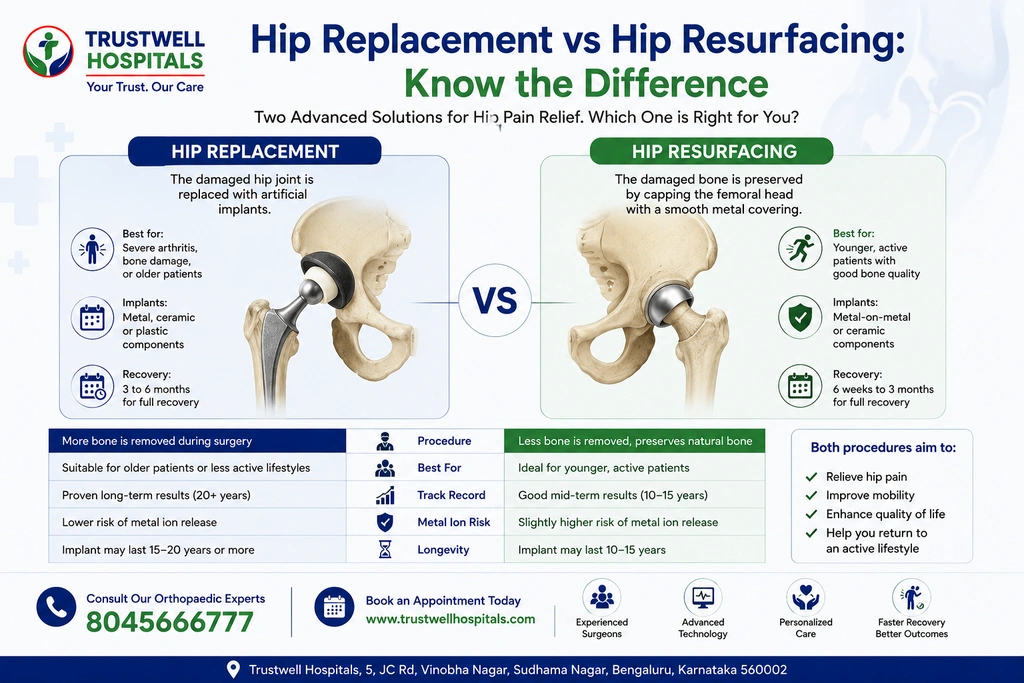
Hip Replacement vs Hip Resurfacing

How Do Hip Replacement and Hip Resurfacing Compare?

Parameter Hip Replacement Hip Resurfacing
Procedure Name Total Hip Replacement Hip Resurfacing
Bone Preservation Femoral head replaced Femoral head largely preserved
Implant Design Stem and socket components Metal cap with socket component
Anaesthesia Spinal or General Anaesthesia Spinal or General Anaesthesia
Procedure Duration 1–3 hours 1–3 hours
Hospital Stay Typically 3–7 days Typically 3–7 days
Recovery Timeline Varies by patient Varies by patient
Typical Candidates Advanced arthritis and severe joint damage Selected younger and active patients

All values are indicative. Treatment selection and expected outcomes vary between patients and are confirmed after clinical evaluation and imaging review.

What Is Hip Replacement?

hip replacement vs hip resurfacing

Hip replacement surgery involves removing damaged portions of the hip joint and replacing them with artificial components. The procedure is commonly performed for advanced arthritis, severe cartilage loss, and conditions that affect joint movement and quality of life.

The artificial joint consists of components that replace both the ball and socket parts of the hip, helping restore movement and reduce pain.

Advantages of Hip Replacement

Suitable for Different Age Groups

Hip replacement is performed across a broad range of age groups, depending on symptoms and overall health.

Extensive Clinical Experience

Orthopaedic surgeons have decades of experience performing total hip replacement procedures.

Various Implant Options

Different implant systems allow treatment planning to be tailored to anatomy and activity requirements.

Widely Available Procedure

Hip replacement is routinely performed at centres offering joint replacement surgery.

Long-Term Clinical Evidence

Published studies have demonstrated favourable long-term outcomes for appropriately selected patients. Individual outcomes vary.

Limitations and Considerations

Bone Removal Is Required

The femoral head is removed and replaced with an artificial component.

Revision Surgery May Be Needed in Some Cases

Implants are designed to provide long-term function, but revision procedures may become necessary over time.

Implant Selection Varies

The choice of implant depends on age, activity levels, and clinical findings.

Recovery Differs Between Patients

Improvement in mobility and function depends on rehabilitation and several individual factors.

Patients interested in procedure-specific information may also explore hip replacement surgery in Bangalore.

Suitability depends on imaging findings and individual clinical factors reviewed by the orthopaedic specialist.

What Is Hip Resurfacing?

Hip resurfacing is a bone-preserving procedure in which the femoral head is reshaped and covered with a metal cap rather than being completely removed. The damaged socket surface is also replaced with an artificial component.

Because more natural bone is preserved, hip resurfacing is sometimes considered for selected younger and active individuals with good bone quality.

Advantages of Hip Resurfacing

Preserves More Bone

The femoral head is largely retained, which may be beneficial in selected patients.

Designed for Active Individuals

Hip resurfacing has traditionally been considered for younger and physically active patients with suitable anatomy.

Larger Femoral Head Size

The implant design uses a larger head component, which may influence stability characteristics.

Potential Revision Options

Preserving bone may provide additional options if future revision surgery becomes necessary.

Established Procedure in Selected Patients

Published evidence supports hip resurfacing in appropriately selected individuals. Individual outcomes vary.

Limitations and Considerations

Not Suitable for Everyone

Bone quality, anatomy, and age influence whether hip resurfacing may be considered.

Fewer Centres Offer the Procedure

Hip resurfacing is performed at selected orthopaedic centres.

Implant Selection Requires Careful Assessment

Certain implant designs and patient factors require detailed evaluation.

Long-Term Outcomes Vary

As with any joint replacement procedure, outcomes depend on multiple factors including rehabilitation and overall health.

Different procedures are used for different clinical situations. Imaging findings and specialist evaluation help determine which approach may be appropriate for an individual patient.

When Is Hip Replacement Typically Considered?

The decision to perform hip replacement depends on imaging findings, symptoms, and individual clinical factors. Treatment recommendations are personalised and confirmed after specialist evaluation.

Situations Where Hip Replacement May Be Considered

Advanced Hip Arthritis

Patients with severe cartilage loss and persistent pain are often evaluated for hip replacement surgery.

Significant Joint Damage

Conditions affecting both the ball and socket portions of the hip may require complete joint reconstruction.

Reduced Mobility

Difficulty walking, climbing stairs, or performing daily activities may influence treatment discussions.

Older Adults With Degenerative Changes

Hip replacement is commonly performed across different age groups, including older adults with advanced arthritis.

Previous Treatments Have Not Provided Adequate Relief

Medication, physiotherapy, and injections may no longer provide sufficient improvement in some cases.

Situations Where Additional Assessment May Be Needed

Younger Active Patients

Alternative procedures, including hip resurfacing, may sometimes be discussed depending on anatomy and bone quality.

Complex Medical Conditions

Overall health and associated medical problems are reviewed before treatment planning.

Previous Hip Surgery

Earlier operations can influence implant selection and surgical planning.

Ultimately, orthopaedic specialists confirm suitability after reviewing imaging findings and individual factors.

When Is Hip Resurfacing Typically Considered?

Hip resurfacing is not suitable for every patient. Recommendations depend on age, bone quality, activity levels, and the extent of joint damage.

Situations Where Hip Resurfacing May Be Considered

Younger and Active Individuals

Hip resurfacing has traditionally been considered for selected younger patients with higher activity levels.

Good Bone Quality

Preservation of the femoral head requires adequate bone strength and suitable anatomy.

Early to Moderate Joint Damage

The condition of the hip and surrounding bone influences treatment planning.

Patients Seeking Bone Preservation

Preserving more natural bone may be an important consideration in selected cases.

Future Revision Planning

Bone preservation may provide additional options if revision surgery becomes necessary later.

Situations Where It May Not Be Recommended

Poor Bone Quality

Reduced bone density may influence implant performance and treatment selection.

Extensive Joint Destruction

Severe arthritis affecting multiple structures may require alternative procedures.

Certain Anatomical Variations

Hip anatomy varies between individuals and can influence suitability.

Some Medical Conditions

Overall health and associated disorders are considered before surgery.

The orthopaedic specialist confirms whether hip resurfacing is appropriate after reviewing imaging and clinical findings.

Which Procedure Is Right for You?

Several factors influence treatment selection. No single factor determines the decision, and the purpose of this section is to help patients understand the reasoning behind procedure recommendations.

Key Factors Considered

Bone Quality

Strong bone stock may influence whether bone-preserving procedures are considered.

Age and Activity Levels

Lifestyle requirements and expected activity after surgery form part of treatment discussions.

Imaging Findings

X-rays and other investigations help assess cartilage loss, deformity, and bone structure.

Severity of Arthritis

Advanced joint damage may influence the extent of reconstruction required.

Previous Treatment History

Prior surgery and earlier interventions can affect implant planning.

Overall Health

Medical conditions and physical fitness are reviewed before deciding on treatment.
Factors Often Considered Hip Replacement Hip Resurfacing
Bone preservation Less emphasis Greater emphasis
Implant design Stem and socket components Metal cap with socket component
Typical age profile Broad age range Selected younger patients
Bone quality requirements Variable Usually higher
Availability Widely available Selected centres

No single factor determines the choice. The most important step is a consultation with an orthopaedic specialist who reviews imaging findings and explains the reasoning behind treatment recommendations.

Why Choose Trustwell Hospitals for Hip Replacement or Hip Resurfacing?

Patients comparing procedures often focus on the differences between them, but successful treatment also depends on diagnosis, individualised planning, surgical expertise, and structured rehabilitation. Access to multiple treatment options allows recommendations to be based on patient requirements rather than a single approach.

Experience Across Different Hip Conditions

Trustwell Hospitals has treated more than 10,000+ orthopaedic patients, including individuals with advanced arthritis, deformities, and failed previous procedures requiring specialised treatment planning.

Imaging-Guided Treatment Planning

With more than 1,500 joint replacement procedures performed, imaging findings and clinical assessment help determine the most appropriate procedure for each patient.

Evidence-Based Outcomes

Published studies have demonstrated favourable outcomes for both hip replacement and hip resurfacing in appropriately selected patients. Individual outcomes vary.

Access to Multiple Joint Reconstruction Options

Broader treatment choices help ensure that recommendations are based on anatomy, age, activity level, and clinical findings rather than a limited set of procedures. Patients interested in other orthopaedic procedures may also explore joint replacement surgery in Bangalore.

Trusted Orthopaedic Services

More than 10,000 orthopaedic consultations have been provided by the department, supported by patient satisfaction scores exceeding 95%.

Structured Follow-Up Support

Rehabilitation, mobility exercises, and regular reviews help support long-term joint function and recovery after surgery.

Meet Our Orthopaedic Specialists

The orthopaedic team at Trustwell Hospitals manages arthritis, fractures, sports injuries, trauma, and complex joint disorders, helping patients regain mobility and improve their quality of life.

Dr Ananya Puttaraju – Senior Consultant & HOD – Orthopaedics

Qualifications: MBBS, MRCS, FRCS (Tr & Ortho), CCBST – UK, Fellowship in Robotic Joint Replacement & Foot and Ankle Surgery Experience: 20+ Years

Areas of Expertise

→ Robotic Knee Replacement Surgery
→ Hip Replacement Surgery
→ Revision Joint Replacement Surgery
→ Foot and Ankle Surgery
→ Complex Arthritis Management
→ Sports Injury Treatment
→ Trauma and Fracture Care

Dr Aditya H Kumar – Associate Consultant Orthopaedic Surgeon

Qualifications: MBBS, MS (Orthopaedics), Fellowship in Limb Reconstruction, Fellowship in Arthroscopy & Arthroplasty Experience: 8+ Years

Areas of Expertise

→ Joint Replacement Surgery
→ Arthroscopy Procedures
→ Sports Injury Management
→ Knee and Shoulder Disorders
→ Trauma and Fracture Care
→ Limb Reconstruction

Dr Pavan Kumar G – Consultant Orthopaedic Surgeon

Qualifications: MBBS, MS (Orthopaedics) Experience: 10+ Years

Areas of Expertise

→ Hip Replacement Surgery
→ Polytrauma and Accident Care
→ Fracture Management
→ Spine Disorders
→ Shoulder Conditions
→ Joint Preservation Procedures
Book an Appointment

Speak with an Orthopaedic Specialist Today

What Do Patients Say About Hip Surgery at Trustwell Hospitals?

4.3 out of 5 from 2,000+ verified Google reviews

★★★★★

“The doctor explained different treatment options clearly and helped us understand which procedure suited my father’s condition. Recovery support was excellent.” Source: GBP

★★★★★

“We appreciated the time taken to explain the advantages and limitations of each approach rather than pushing a single procedure.” Source: GBP

★★★★★

“The team guided us throughout the process and answered all our questions patiently.” Source: GBP

Is Trustwell Hospitals Accredited and Recognised for Orthopaedic Care?

Trustwell Hospitals follows recognised standards of patient safety and quality care.

NABH Accreditation

NABH accreditation reflects adherence to established standards relating to patient safety, quality, and clinical governance.

Awards and Recognition

Trustwell Hospitals has received recognitions for healthcare excellence and patient care initiatives.

Where Is Trustwell Hospitals Located and When Can You Visit?

Trustwell Hospitals is located in central Bengaluru and provides orthopaedic consultations throughout the week.

Address

5, JC Rd, Vinobha Nagar, Sudhama Nagar, Bengaluru, Karnataka 560002

Phone

80 4566 6777

OPD Hours

OPD Hours: 10:00 AM to 4:00 PM

Parking Facilities

Available

Nearby Transportation and Landmarks

Bengaluru City Railway Station (KSR Bengaluru): Approximately 4–5 km away, easily accessible by taxi, auto-rickshaw, and metro. Kempegowda Bus Station (Majestic): Approximately 4–5 km away and connected to different parts of Bengaluru and nearby cities. Kempegowda International Airport: Approximately 35–40 km away with cab and airport shuttle services available. Lalbagh Metro Station: Approximately 2–3 km away and conveniently connected through Namma Metro. Cubbon Park Metro Station: Approximately 3–4 km away and accessible from major residential and commercial areas. Lalbagh Botanical Garden: Located nearby and serves as a well-known landmark for visitors. Bengaluru Town Hall: Approximately 1–2 km away and easily identifiable for patients navigating to the hospital. Victoria Hospital and BMCRI Campus: Situated in the vicinity, making the area familiar to many patients and caregivers.

Areas We Serve

Patients regularly visit Trustwell Hospitals from Jayanagar (4–6 km), Basavanagudi (3–5 km), Richmond Town (2–4 km), Koramangala (5–8 km), Malleshwaram (6–8 km), Rajajinagar (7–9 km), Indiranagar (7–10 km), and surrounding areas across Bengaluru.

Frequently Asked Questions About Hip Replacement vs Hip Resurfacing

Does hip resurfacing use a different implant from hip replacement?

Yes. Hip resurfacing preserves much of the femoral head and uses a metal cap, whereas total hip replacement involves replacing the femoral head with a stem and ball component. Implant selection depends on anatomy and clinical findings.

Is hip resurfacing more suitable for athletes?

Hip resurfacing has historically been considered for selected younger and active individuals. However, suitability depends on bone quality, anatomy, and overall health rather than activity levels alone.

Can women undergo hip resurfacing?

Yes. However, factors such as bone density and anatomy are carefully evaluated before considering hip resurfacing. Recommendations vary between patients.

Will airport security scanners detect the implant?

Metal implants may occasionally trigger security alarms. Patients can inform airport personnel if required, although special documentation is generally unnecessary.

Can I undergo MRI scans after surgery?

Most modern implants are MRI-compatible, but patients should always inform healthcare professionals about previous joint replacement procedures before imaging.

Which procedure leaves a smaller scar?

Scar size depends primarily on surgical technique, patient anatomy, and healing characteristics rather than the type of procedure alone.

Can both hips be treated at the same time?

In selected patients, bilateral procedures may be considered. The decision depends on age, overall health, and the extent of joint disease.

How long do the implants usually last?

Modern implants are designed to provide long-term function, and many can last 15–20 years or longer. Longevity depends on activity levels, body weight, implant type, and adherence to rehabilitation recommendations.

Can patients travel after surgery?

Yes. Most patients can travel after recovery, although long journeys may require precautions such as hydration, regular movement, and following medical advice regarding blood clot prevention.

Will weather changes affect the implant?

Some patients report temporary discomfort during changes in weather, although scientific evidence remains limited. Symptoms vary between individuals.

Is revision surgery possible after either procedure?

Yes. Revision surgery may be performed if implants wear out, loosen, or complications affect joint function. Treatment strategies depend on the previous procedure and individual anatomy.

Are there non-surgical alternatives to these procedures?

Yes. Medication, physiotherapy, weight management, activity modification, and injections may help selected patients. Surgery is generally considered when conservative measures no longer provide adequate relief.
Book a Consultation

📞 80 4566 6777

Book an Appointment