A New Milestone: Successfully accredited with NABH 6th Edition – Redefining standards in healthcare quality and patient safety | Live vitals. Real-time data. Faster care. Trustwell Hospitals unveils Karnataka’s first 5G SMART ambulance |
Find a Doctor Book Online Appointment
Knee Osteotomy vs Knee Replacement

Knee Osteotomy vs Knee Replacement

Knee Osteotomy vs Knee Replacement

knee osteotomy vs knee replacement

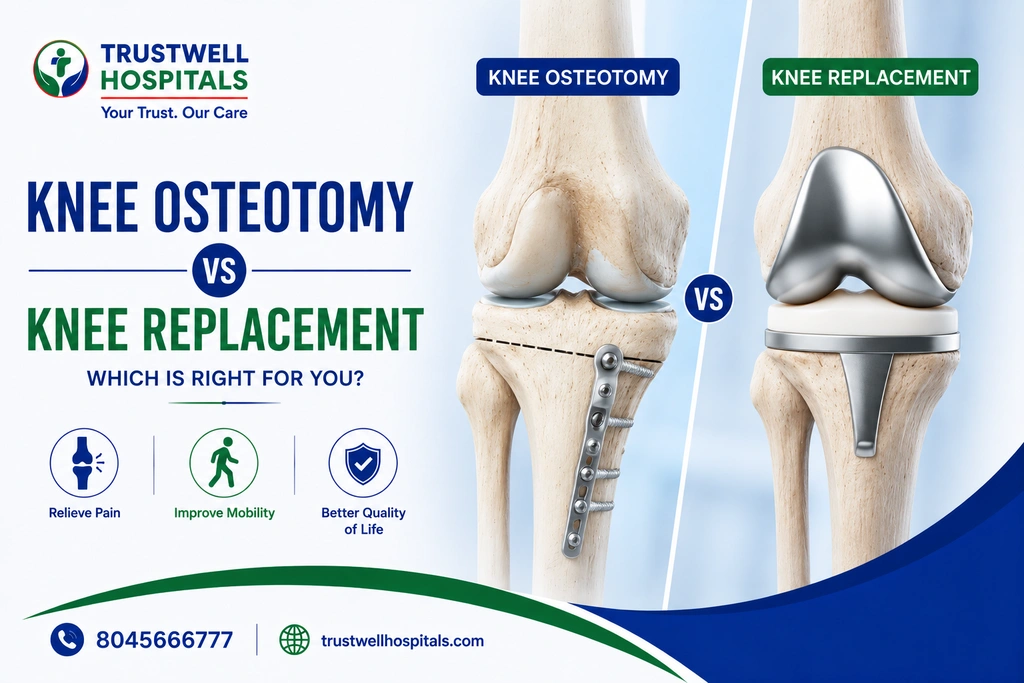
Knee Osteotomy and Knee Replacement are two established surgical procedures used to treat knee pain caused by arthritis and joint damage. While Knee Osteotomy preserves the natural joint by realigning the leg, Knee Replacement replaces damaged joint surfaces with artificial implants. The most appropriate procedure depends on the location of arthritis, knee alignment, age, activity level, and overall joint condition. This guide explains both options to help you have a more informed discussion with your orthopaedic specialist.

How Do Knee Osteotomy and Knee Replacement Compare?

Parameter Knee Osteotomy Knee Replacement
Procedure Type Bone realignment surgery Joint replacement surgery
Primary Goal Redistribute body weight to reduce pressure on the damaged part of the knee Replace worn cartilage and damaged joint surfaces with artificial implants
Joint Preservation Preserves the natural knee joint Damaged joint surfaces are replaced
Anaesthesia General or spinal anaesthesia General or spinal anaesthesia
Typical Procedure Duration Approximately 1.5–3 hours Approximately 1.5–3 hours
Hospital Stay Usually 2–4 days Usually 2–4 days
Recovery Progressive rehabilitation over several months Progressive rehabilitation over several months
Implant Used Bone plate and screws Artificial knee implant
Commonly Considered For Younger patients with arthritis limited to one compartment Advanced arthritis affecting multiple compartments
The information above is indicative. Your orthopaedic specialist determines the most appropriate procedure after reviewing your symptoms, examination findings, X-rays, and overall knee condition.

What Is Knee Osteotomy?

Knee Osteotomy is a joint-preserving procedure that changes the alignment of the leg by cutting and reshaping either the shin bone (tibia) or thigh bone (femur). The goal is to shift body weight away from the damaged part of the knee toward the healthier cartilage, helping reduce pain and improve knee function. Unlike joint replacement, the natural knee is retained. The corrected bone position is stabilised using specialised plates and screws while the bone gradually heals.

Advantages of Knee Osteotomy

✔ Preserves the Natural Knee

The procedure maintains the patient’s own knee joint rather than replacing it with an artificial implant.

✔ Redistributes Joint Loading

Correcting limb alignment reduces pressure on the arthritic compartment, which may improve comfort during daily activities.

✔ May Delay Joint Replacement

For selected patients, osteotomy can postpone the need for knee replacement by preserving the natural joint for longer.

✔ Suitable for Active Individuals

Some younger or physically active patients with localised arthritis may be evaluated for this joint-preserving procedure.

Limitations and Considerations

Recovery Requires Bone Healing

Since the procedure involves cutting and realigning bone, healing takes time and requires a structured rehabilitation programme.

Not Appropriate for Every Pattern of Arthritis

Osteotomy is generally considered when arthritis affects only one part of the knee rather than the entire joint.

Internal Fixation Is Required

Plates and screws are used to maintain the corrected alignment until the bone heals adequately.

Future Surgery May Still Be Needed

Some patients may eventually require knee replacement if arthritis progresses over time. The timing varies between individuals. Your orthopaedic specialist confirms whether Knee Osteotomy is appropriate after assessing X-rays, knee alignment, cartilage damage, and overall joint health.

What Is Knee Replacement?

Knee Replacement is a procedure in which damaged cartilage and worn joint surfaces are removed and replaced with artificial implants designed to restore movement and reduce pain caused by advanced arthritis. Depending on the extent of joint damage, the procedure may involve replacing the entire knee joint or only the affected compartment. Treatment planning is individualised after clinical examination and imaging studies.

Advantages of Knee Replacement

✔ Addresses Advanced Joint Damage

The procedure replaces severely damaged joint surfaces that are contributing to pain, stiffness, and reduced mobility.

✔ Improves Knee Function

Many patients experience better joint movement and improved ability to perform everyday activities following rehabilitation.

✔ Suitable for Extensive Arthritis

Knee replacement is commonly considered when arthritis affects multiple compartments and conservative treatment no longer provides adequate relief.

✔ Long-Term Treatment Option

Modern knee implants are designed for long-term function, although longevity varies depending on activity level, overall health, body weight, and rehabilitation.

Limitations and Considerations

Rehabilitation Remains Essential

Recovery depends on physiotherapy, muscle strengthening, and regular follow-up regardless of the surgical technique used.

Implant Longevity Varies

Although modern implants are designed for long-term use, they may eventually require revision surgery in some patients depending on multiple factors.

Not Every Patient Requires Replacement

Patients with early or localised arthritis may have other treatment options that are considered before joint replacement.

Treatment Is Individualised

The decision depends on imaging findings, symptoms, knee stability, alignment, age, activity level, and overall health rather than one factor alone.

When Is Knee Osteotomy Typically Recommended?

Knee Osteotomy is generally considered for selected patients with localised arthritis and abnormal knee alignment. The decision depends on clinical examination, standing X-rays, cartilage condition, ligament stability, and overall joint health rather than age alone.

Knee Osteotomy May Be Considered When

Arthritis Is Limited to One Knee Compartment

The procedure is commonly evaluated when cartilage damage is confined to either the inner or outer compartment while the remaining joint surfaces remain relatively healthy.

Knee Alignment Has Changed

Bow-legged (varus) or knock-kneed (valgus) alignment can increase pressure on one side of the knee. Correcting alignment may help redistribute weight more evenly across the joint.

Joint Preservation Is a Treatment Goal

For selected patients, preserving the natural knee joint may be considered before discussing joint replacement surgery.

Good Knee Range of Motion

Patients with satisfactory knee movement and stable ligaments may be evaluated for osteotomy depending on the extent of cartilage damage.

Conservative Treatment No Longer Provides Relief

When physiotherapy, medications, weight management, activity modification, or injections no longer adequately control symptoms, surgical options may be discussed.

When Knee Osteotomy May Not Be Recommended

  • Arthritis affects multiple compartments of the knee.
  • Significant loss of knee movement is present.
  • Advanced inflammatory arthritis involves the entire joint.
  • Severe joint degeneration makes joint-preserving surgery less suitable.
The final recommendation is based on imaging studies, clinical assessment, and the patient’s long-term treatment goals.

When Is Knee Replacement Typically Recommended?

Knee Replacement is considered when arthritis causes significant pain, stiffness, and reduced mobility that continue despite appropriate conservative treatment. Suitability is confirmed after detailed clinical evaluation and imaging.

Knee Replacement May Be Considered When

Advanced Arthritis Involving Multiple Compartments

Patients with widespread cartilage loss affecting several parts of the knee may be evaluated for joint replacement.

Persistent Pain Affects Everyday Activities

Difficulty walking, climbing stairs, standing for prolonged periods, or performing routine activities despite non-surgical treatment may influence treatment planning.

Pain Continues During Rest or Sleep

Advanced joint degeneration may lead to discomfort even while resting, affecting sleep quality and daily well-being.

Conservative Treatment Is No Longer Effective

When medications, physiotherapy, injections, and lifestyle modifications fail to provide adequate relief, knee replacement may become one of the treatment options discussed.

Imaging Shows Extensive Joint Damage

X-rays demonstrating advanced cartilage loss, joint narrowing, deformity, or bone changes contribute to surgical decision-making.

When Knee Replacement May Not Be Recommended

  • Arthritis remains limited to one compartment and joint-preserving surgery is appropriate.
  • Symptoms respond well to conservative treatment.
  • Medical conditions require optimisation before surgery.
  • The degree of arthritis does not yet warrant joint replacement.
Your orthopaedic specialist determines the most appropriate procedure after evaluating your symptoms, examination findings, and imaging studies.

Which Procedure Is Right for You?

There is no single procedure that is suitable for every patient. The decision depends on several clinical factors that help determine whether preserving the natural joint or replacing it is more appropriate.

Extent of Cartilage Damage

The amount and location of cartilage loss are among the most important considerations. Localised arthritis may lead to different treatment discussions than advanced degeneration involving the entire knee.

Knee Alignment

Abnormal alignment can influence how body weight is distributed across the joint and may affect whether an osteotomy is considered.

Age and Activity Level

Daily activities, occupational demands, exercise goals, and long-term expectations all contribute to selecting the most appropriate treatment.

Knee Stability and Function

Ligament integrity, range of motion, muscle strength, and overall knee function are carefully assessed before recommending surgery.

General Health

Overall fitness, bone quality, medical conditions, and recovery expectations all influence treatment planning.

Long-Term Treatment Strategy

Your surgeon considers both your current symptoms and future joint health when recommending a procedure that aligns with your individual needs.
Clinical Consideration Knee Osteotomy May Be Considered Knee Replacement May Be Considered
Arthritis Pattern One knee compartment Multiple knee compartments
Natural Joint Preserved Damaged joint surfaces replaced
Knee Alignment Correction of abnormal alignment Alignment addressed during joint replacement
Typical Patient Profile Selected patients with localised arthritis Patients with advanced joint degeneration
Rehabilitation Required after surgery Required after surgery
Every patient’s knee condition is unique. Clinical examination, standing X-rays, knee alignment, cartilage wear, and functional goals all contribute to determining the most appropriate treatment. Patients considering joint replacement may also find our guide on Total Knee Replacement vs Partial Knee Replacement helpful for understanding the available replacement options.

Why Choose Trustwell Hospitals for Knee Osteotomy or Knee Replacement?

Selecting between Knee Osteotomy and Knee Replacement requires careful evaluation of joint damage, knee alignment, lifestyle, and long-term treatment goals. Trustwell Hospitals provides comprehensive orthopaedic care, helping patients receive the most appropriate procedure based on their individual condition rather than a one-size-fits-all approach.

10+ Years of Orthopaedic Experience

With over 10 years of orthopaedic experience, the department manages knee arthritis, deformity correction, sports injuries, complex joint disorders, and advanced joint replacement procedures.

Thousands of Orthopaedic Patients Treated

The orthopaedic team has treated thousands of patients with arthritis, knee injuries, fractures, and musculoskeletal conditions using personalised treatment plans.

90%+ Patient Satisfaction

More than 90% patient satisfaction reflects the department’s commitment to evidence-based care, transparent communication, and rehabilitation-focused recovery.

Personalised Surgical Planning

Every patient undergoes a detailed clinical evaluation, standing X-rays, and advanced imaging to determine whether joint-preserving osteotomy or knee replacement is the more appropriate treatment.

Advanced Joint Replacement Technology

Trustwell Hospitals offers both robotic-assisted and conventional knee replacement surgery, allowing treatment to be tailored according to each patient’s anatomy and clinical requirements when appropriate.

Hundreds of Knee Procedures Performed

The orthopaedic department has performed hundreds of knee procedures, including knee replacement, deformity correction, arthroscopy, ligament reconstruction, and joint preservation surgeries.

Cashless Insurance Assistance

Dedicated patient coordinators assist with insurance verification, pre-authorisation, documentation, cashless approvals, reimbursement guidance, and discharge formalities.

NABH 6th Edition Certified Hospital

Trustwell Hospitals is NABH 6th Edition Certified and maintains a 4.3 Google Rating, reflecting its commitment to recognised standards of patient safety and quality healthcare. 📞 Call 804566 6777

Frequently Asked Questions About Knee Osteotomy vs Knee Replacement

What is the main difference between Knee Osteotomy and Knee Replacement?

Knee Osteotomy preserves the natural knee by correcting bone alignment, whereas Knee Replacement removes damaged joint surfaces and replaces them with artificial implants. The choice depends on the extent of arthritis and overall knee condition.

Is Knee Osteotomy only suitable for younger patients?

Age is only one consideration. Knee alignment, cartilage damage, activity level, ligament stability, and overall joint health are equally important when determining suitability.

Can Knee Osteotomy delay Knee Replacement?

In selected patients with localised arthritis, Knee Osteotomy may help postpone the need for Knee Replacement. The outcome varies depending on the progression of arthritis and individual factors.

Which procedure has a longer recovery?

Both surgeries require rehabilitation. Recovery timelines vary according to the procedure performed, bone healing, muscle strength, physiotherapy, and each patient’s overall health.

Can arthritis return after Knee Osteotomy?

The procedure does not stop the natural progression of arthritis. Some patients may eventually require Knee Replacement if degeneration develops in other parts of the knee.

Does Knee Replacement completely restore a normal knee?

The goal is to reduce pain and improve function. While many patients return to daily activities comfortably, an artificial joint does not function exactly like a natural knee.

How does the surgeon decide which procedure is appropriate?

The decision is based on symptoms, standing X-rays, MRI findings when required, knee alignment, cartilage wear, activity level, age, and long-term treatment goals.

Is physiotherapy important after both procedures?

Yes. Physiotherapy plays a key role after both Knee Osteotomy and Knee Replacement by improving strength, flexibility, walking ability, balance, and overall recovery..
Book an Appointment