A New Milestone: Successfully accredited with NABH 6th Edition – Redefining standards in healthcare quality and patient safety | Live vitals. Real-time data. Faster care. Trustwell Hospitals unveils Karnataka’s first 5G SMART ambulance |
Find a Doctor Book Online Appointment
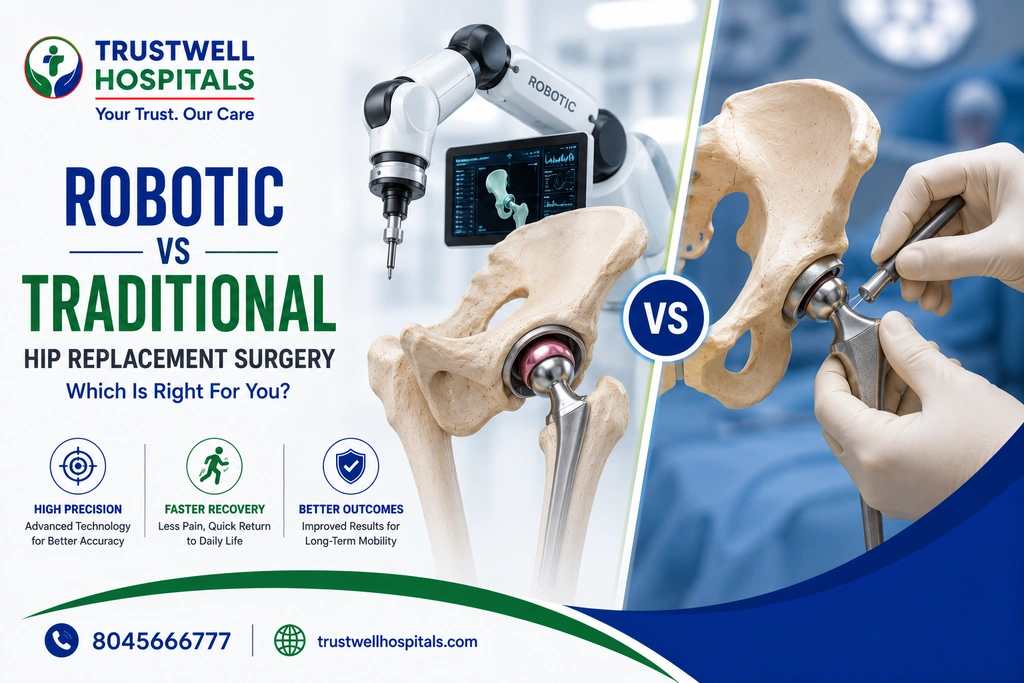
Robotic vs Traditional Hip Replacement Surgery

Robotic vs Traditional Hip Replacement Surgery

Robotic vs Traditional Hip Replacement Surgery

robotic vs traditional hip replacement surgery

Robotic Hip Replacement Surgery and Traditional Hip Replacement Surgery are two established approaches used to treat advanced hip arthritis and other conditions affecting the hip joint. Both procedures replace the damaged hip joint with an artificial implant, but they differ in how the surgery is planned and performed. This guide explains the differences to help you better understand each approach before discussing your treatment options with an orthopaedic specialist.

How Do Robotic and Traditional Hip Replacement Surgery Compare?

Parameter Robotic Hip Replacement Traditional Hip Replacement
Procedure Type Robot-assisted hip replacement Conventional hip replacement
Surgical Planning Computer-assisted pre-operative planning Surgeon-guided planning based on imaging and clinical assessment
Implant Placement Robot-assisted guidance during surgery Manual implant positioning by the surgeon
Anaesthesia General or spinal anaesthesia General or spinal anaesthesia
Typical Procedure Duration Approximately 90–150 minutes Approximately 90–150 minutes
Hospital Stay Typically 2–4 days Typically 2–4 days
Recovery Progressive rehabilitation over several months Progressive rehabilitation over several months
Surgical Incision Incision required Incision required
Commonly Considered For Patients suitable for robotic-assisted surgery Patients suitable for conventional hip replacement
The information above is indicative. Your orthopaedic surgeon confirms the most appropriate approach after reviewing your symptoms, examination findings, imaging studies, and overall health.

What Is Robotic Hip Replacement Surgery?

Robotic Hip Replacement Surgery is a joint replacement procedure performed with the assistance of computer-guided robotic technology. Before surgery, specialised software creates a detailed surgical plan using imaging studies. During the operation, the robotic system assists the surgeon in positioning the implants according to the pre-planned measurements while the surgeon remains in complete control throughout the procedure. The robotic platform does not perform the operation independently. Instead, it provides real-time guidance that supports accuracy during bone preparation and implant positioning.

Advantages of Robotic Hip Replacement Surgery

✔ Personalised Surgical Planning

Computer-assisted planning allows the procedure to be tailored to each patient’s anatomy using detailed pre-operative imaging.

✔ Precision-Guided Implant Placement

Robotic guidance assists the surgeon in positioning the hip implant according to the planned alignment and measurements.

✔ Real-Time Surgical Assistance

The robotic platform provides continuous feedback during surgery, helping the surgeon make informed adjustments whenever required.

✔ Consistent Surgical Execution

Technology-assisted planning may help improve consistency during implant positioning in appropriately selected patients.

Limitations and Considerations

Requires Specialised Equipment

Robotic hip replacement can only be performed in centres equipped with dedicated robotic surgical systems.

Not Every Patient Requires Robotic Assistance

The choice of surgical technique depends on clinical assessment, imaging findings, and the surgeon’s judgement rather than patient preference alone.

Implant Selection Still Depends on Clinical Factors

The robotic system assists with planning and guidance, but implant selection continues to depend on the patient’s anatomy, bone quality, and overall hip condition.

Rehabilitation Remains Essential

Recovery depends on structured physiotherapy, muscle strengthening, and regular follow-up regardless of the surgical technique used. Your orthopaedic surgeon determines whether robotic-assisted hip replacement is appropriate after evaluating your hip condition and imaging studies.

What Is Traditional Hip Replacement Surgery?

Traditional Hip Replacement Surgery is the conventional method of replacing a damaged hip joint with an artificial implant. The procedure has been performed successfully for many years and relies on the surgeon’s clinical expertise, pre-operative planning, anatomical assessment, and intra-operative judgement to position the implants accurately. Although advanced imaging is used before surgery, implant positioning is guided by the surgeon’s experience and established surgical techniques rather than robotic assistance.

Advantages of Traditional Hip Replacement Surgery

✔ Well-Established Surgical Technique

Traditional hip replacement has been widely performed for decades using proven surgical principles and established clinical protocols.

✔ Suitable for a Wide Range of Patients

Many patients with hip arthritis, avascular necrosis, fractures, and other joint conditions may be evaluated for conventional hip replacement depending on their clinical findings.

✔ Surgeon-Led Decision Making

Every aspect of implant positioning and surgical execution is performed directly by the operating surgeon based on intra-operative assessment.

✔ Broad Availability

Traditional hip replacement is available at most centres performing joint replacement surgery and remains a commonly used treatment approach.

Limitations and Considerations

Surgical Planning Is Primarily Manual

Although imaging guides treatment planning, implant positioning relies mainly on the surgeon’s expertise and anatomical assessment during surgery.

Precision Depends on Multiple Factors

Implant positioning is influenced by surgical experience, anatomy, and intra-operative findings rather than computer-assisted guidance.

Recovery Varies Between Patients

Recovery timelines depend on overall health, rehabilitation, muscle strength, and adherence to physiotherapy rather than the surgical technique alone.

Individual Suitability Varies

The decision between robotic-assisted and traditional hip replacement is based on clinical evaluation, imaging findings, and the surgeon’s recommendation rather than one approach being universally preferred.

When Is Robotic Hip Replacement Surgery Typically Recommended?

Whether robotic-assisted hip replacement is appropriate depends on several clinical factors rather than technology alone. Your orthopaedic surgeon evaluates imaging findings, hip anatomy, bone quality, arthritis severity, and overall health before recommending the surgical approach.

Robotic Hip Replacement Surgery May Be Considered When

Advanced Hip Arthritis Is Present

Patients with significant cartilage loss causing persistent pain, stiffness, and reduced mobility may be evaluated for robotic-assisted joint replacement.

Personalised Implant Planning Is Beneficial

Detailed computer-assisted planning may help the surgeon prepare an implant strategy based on the patient’s individual hip anatomy.

Accurate Implant Positioning Is a Priority

Robotic guidance provides real-time information during surgery to support planned implant positioning while the surgeon remains in complete control.

Complex Hip Anatomy Requires Detailed Planning

Patients with anatomical variations or deformities may benefit from additional pre-operative planning depending on the surgeon’s assessment.

Conservative Treatment No Longer Provides Relief

When medications, physiotherapy, lifestyle modifications, and injections no longer adequately control symptoms, hip replacement surgery may be discussed.

When Robotic Hip Replacement May Not Be Recommended

  • Robotic technology is not clinically necessary for the patient’s condition.
  • Certain anatomical or medical factors influence the surgical approach.
  • Other hip-preserving procedures remain appropriate.
  • The surgeon determines that conventional hip replacement is more suitable after evaluation.
The final decision is based on clinical examination, imaging findings, and individual treatment goals.

When Is Traditional Hip Replacement Surgery Typically Recommended?

Traditional Hip Replacement Surgery remains a widely performed procedure and may be considered for many patients with advanced hip disease. The decision depends on the severity of joint damage, functional limitations, and the surgeon’s clinical assessment.

Traditional Hip Replacement Surgery May Be Considered When

Advanced Degenerative Hip Disease

Patients with osteoarthritis, rheumatoid arthritis, avascular necrosis, or other conditions causing severe joint damage may be evaluated for conventional hip replacement.

Persistent Pain Affects Daily Activities

Hip pain that interferes with walking, climbing stairs, sleeping, or routine activities despite conservative treatment may prompt consideration of surgery.

Hip Joint Damage Is Confirmed on Imaging

X-rays and other imaging studies demonstrating significant cartilage loss or structural damage contribute to treatment planning.

Proven Surgical Technique Is Appropriate

Traditional hip replacement continues to be an established option for patients whose clinical findings are suitable for conventional surgery.

Individual Clinical Assessment Supports This Approach

The surgeon may recommend a conventional procedure when it best matches the patient’s anatomy, medical condition, and surgical requirements.

When Traditional Hip Replacement May Not Be Recommended

  • Hip-preserving treatment remains appropriate.
  • Medical conditions require optimisation before surgery.
  • The surgeon believes robotic assistance may offer additional planning benefits for the individual case.
  • Symptoms do not yet warrant joint replacement.
Your orthopaedic surgeon confirms the most appropriate approach after reviewing your examination findings and imaging studies.

Which Approach Is Right for You?

Choosing between robotic-assisted and traditional hip replacement involves several important considerations. Understanding these factors can help you prepare meaningful questions before your consultation.

Severity of Hip Joint Damage

The amount of cartilage loss, bone damage, and arthritis visible on imaging helps determine whether hip replacement is appropriate and assists with surgical planning.

Individual Hip Anatomy

Every patient’s hip anatomy is unique. Bone shape, alignment, leg length considerations, and anatomical variations may influence surgical planning.

Implant Positioning Strategy

Both approaches aim to position the implant accurately. Robotic surgery uses computer-guided planning, while traditional surgery relies on the surgeon’s experience and intra-operative judgement.

Overall Health

General health, bone quality, medical conditions, previous surgeries, and body weight all contribute to treatment planning.

Recovery and Rehabilitation

Recovery depends more on physiotherapy, muscle strengthening, and adherence to rehabilitation than on the surgical approach alone.

Surgeon’s Clinical Assessment

The most appropriate technique is determined after reviewing clinical findings, imaging studies, and the patient’s treatment goals rather than selecting one method for every individual.
Clinical Consideration Robotic Hip Replacement May Be Considered Traditional Hip Replacement May Be Considered
Surgical Planning Computer-assisted planning Conventional pre-operative planning
Implant Positioning Robot-assisted guidance Surgeon-guided positioning
Anatomical Assessment Detailed digital planning Clinical and imaging-based planning
Technology Used Robotic platform Conventional surgical instruments
Rehabilitation Essential after surgery Essential after surgery
Every patient is different. Imaging findings, hip anatomy, overall health, and clinical assessment all contribute to selecting the most appropriate surgical approach. Patients comparing joint replacement technologies may also find our Robotic vs Traditional Knee Replacement guide helpful for understanding how robotic assistance is used in orthopaedic surgery.

Why Choose Trustwell Hospitals for Robotic or Traditional Hip Replacement Surgery?

Choosing between robotic-assisted and traditional hip replacement involves more than selecting a surgical technique. Successful outcomes depend on accurate diagnosis, personalised treatment planning, experienced orthopaedic surgeons, and structured rehabilitation. Trustwell Hospitals offers comprehensive joint replacement care to help patients receive the most appropriate treatment for their individual condition.

10+ Years of Orthopaedic Experience

With over 10 years of orthopaedic experience, the department manages hip arthritis, avascular necrosis, complex joint disorders, revision joint replacement, and trauma-related hip conditions.

Thousands of Orthopaedic Patients Treated

The orthopaedic team has treated thousands of patients with hip, knee, shoulder, spine, and sports-related conditions through personalised treatment plans designed around each patient’s needs.

90%+ Patient Satisfaction 

More than 90% patient satisfaction reflects the department’s commitment to personalised care, transparent communication, and rehabilitation-focused recovery.

Robotic and Conventional Joint Replacement Expertise

Trustwell Hospitals offers both robotic-assisted and conventional joint replacement surgery, allowing treatment recommendations to be based on the patient’s clinical condition rather than a single surgical technique.

Hundreds of Joint Replacement Procedures Performed

The orthopaedic department has performed hundreds of joint replacement procedures, including primary hip replacement, revision joint replacement, and robotic-assisted joint replacement surgeries.

Advanced Diagnostic and Surgical Planning

Comprehensive clinical assessment, digital imaging, and personalised surgical planning help determine the most appropriate treatment approach while supporting accurate implant positioning.

Cashless Insurance Assistance

Dedicated coordinators assist patients with insurance verification, pre-authorisation, documentation, cashless approvals, reimbursement guidance, and discharge formalities.

NABH 6th Edition Certified Hospital

Trustwell Hospitals is NABH 6th Edition Certified and maintains a 4.3 Google Rating, reflecting its commitment to recognised standards of patient safety and quality healthcare. 📞 Call 8045666777

Frequently Asked Questions About Robotic vs Traditional Hip Replacement Surgery

Is robotic hip replacement better than traditional hip replacement?

Neither approach is universally better. Both are established surgical techniques, and the most appropriate option depends on the patient’s anatomy, hip condition, imaging findings, and the surgeon’s clinical assessment.

Does a robot perform the hip replacement surgery?

No. The orthopaedic surgeon performs the operation. The robotic system provides computer-guided planning and real-time assistance during implant positioning while the surgeon remains in complete control.

Do robotic and traditional hip replacements use the same implants?

In many cases, similar implant systems may be used. The difference lies in the planning and implant positioning process rather than the implant itself.

Is recovery faster after robotic hip replacement?

Recovery varies between patients. Physiotherapy, muscle strength, overall health, and adherence to rehabilitation generally have a greater influence on recovery than the surgical technique alone.

Can every patient undergo robotic hip replacement?

No. Suitability depends on imaging findings, hip anatomy, bone quality, medical history, and the surgeon’s evaluation. Not every patient requires robotic assistance.

Is physiotherapy necessary after both procedures?

Yes. Rehabilitation is an essential part of recovery after both robotic and traditional hip replacement, helping restore mobility, strength, balance, and hip function.

Is there a cost difference between robotic and traditional hip replacement?

Yes, costs may differ because of technology, implants, investigations, hospital stay, and other treatment-related factors. The final estimate is provided after clinical evaluation and treatment planning.

Who decides whether robotic or traditional surgery is appropriate?

The orthopaedic surgeon recommends the most appropriate approach after reviewing your symptoms, physical examination, imaging studies, and treatment goals. This comparison is intended to support that discussion rather than replace it.
Book an Appointment