A New Milestone: Successfully accredited with NABH 6th Edition – Redefining standards in healthcare quality and patient safety | Live vitals. Real-time data. Faster care. Trustwell Hospitals unveils Karnataka’s first 5G SMART ambulance |
Find a Doctor Book Online Appointment
Total Knee Replacement vs Partial Knee Replacement

Total Knee Replacement vs Partial Knee Replacement

Total Knee Replacement vs Partial Knee Replacement

total knee replacement vs partial knee replacement

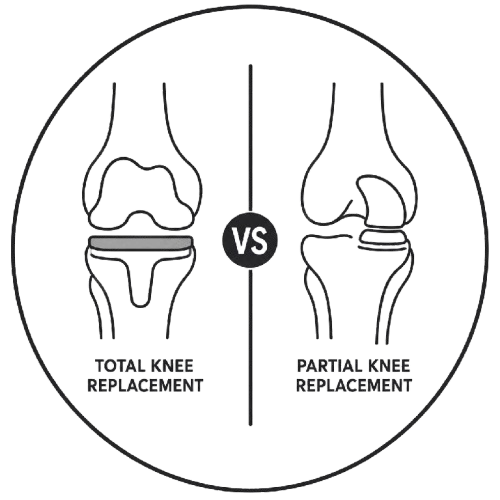
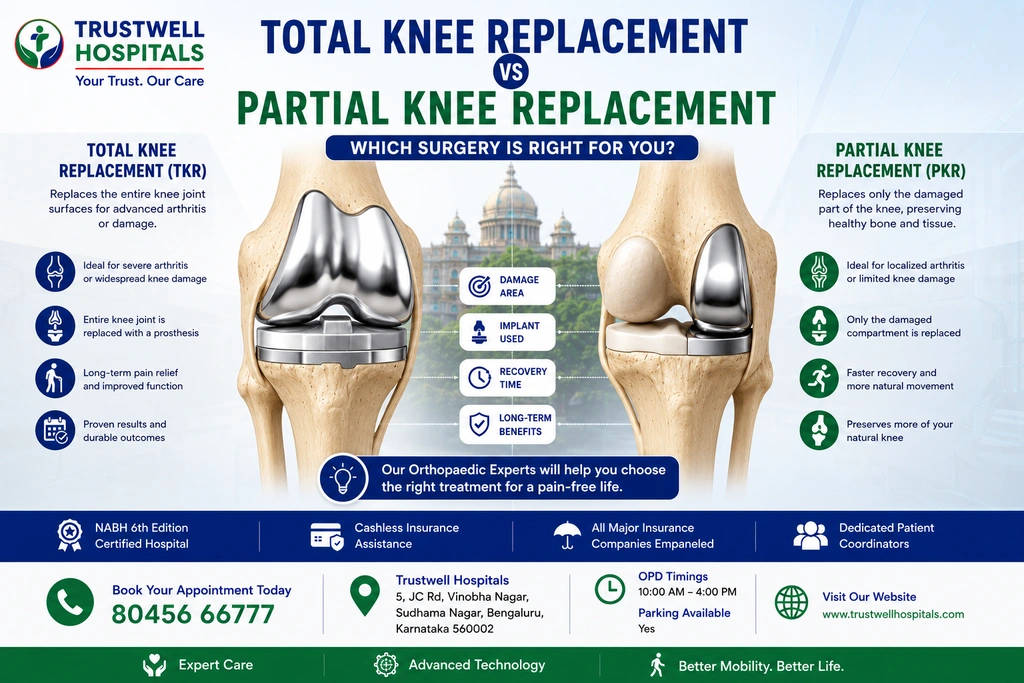
Total Knee Replacement and Partial Knee Replacement are two established surgical procedures used to treat knee arthritis and joint damage. The main difference is that a Total Knee Replacement resurfaces the entire knee joint, whereas a Partial Knee Replacement replaces only the damaged compartment. This guide explains how the two procedures differ, when each is typically considered, and which factors your orthopaedic surgeon evaluates before recommending treatment.

How Do Total Knee Replacement and Partial Knee Replacement Compare?

Parameter Total Knee Replacement Partial Knee Replacement
Full Procedure Name Total Knee Arthroplasty (TKA) Unicompartmental Knee Arthroplasty (UKA)
Area Replaced Entire knee joint Only the damaged compartment
Incision Surgical incision required Usually a smaller surgical incision
Anaesthesia General or spinal anaesthesia General or spinal anaesthesia
Typical Procedure Duration Approximately 90–150 minutes Approximately 60–120 minutes
Hospital Stay Typically 2–4 days Typically 1–3 days
Recovery to Daily Activities Usually several weeks, depending on rehabilitation Often slightly earlier, depending on rehabilitation
Implant Coverage All three knee compartments One knee compartment only
Commonly Considered For Advanced arthritis affecting multiple compartments Arthritis confined to a single compartment
The values above are indicative. Your orthopaedic surgeon confirms the most appropriate procedure after reviewing your symptoms, examination findings, and imaging studies.

What Is Total Knee Replacement?

Total Knee Replacement, also called Total Knee Arthroplasty (TKA), is a procedure in which the damaged cartilage and bone surfaces of the entire knee joint are replaced with artificial components. The surgeon resurfaces the femur (thigh bone), tibia (shin bone), and, when clinically appropriate, the underside of the kneecap to improve joint function and reduce arthritis-related pain. The objective is to restore smoother joint movement while preserving as much healthy bone and surrounding soft tissue as possible. The exact surgical technique and implant selection depend on the patient’s anatomy, the severity of arthritis, and clinical findings.

Advantages of Total Knee Replacement

✔ Addresses Widespread Arthritis

The procedure is typically considered when arthritis affects more than one compartment of the knee rather than a single isolated area.

✔ Comprehensive Joint Reconstruction

Replacing all affected joint surfaces may help improve alignment and overall knee function in appropriately selected patients.

✔ Suitable for Advanced Degeneration

It is commonly performed for patients with advanced osteoarthritis, rheumatoid arthritis, or extensive cartilage loss involving multiple parts of the knee.

✔ Long-Term Implant Performance

Modern knee implants are designed for long-term durability, although implant lifespan varies depending on activity level, overall health, body weight, and other patient-specific factors.

Limitations and Considerations

Entire Joint Is Replaced

Because all compartments are resurfaced, the operation is generally more extensive than a partial knee replacement.

Recovery May Take Longer

Recovery timelines vary between patients and depend on rehabilitation, muscle strength, general health, and adherence to physiotherapy.

Not Every Patient Requires Total Replacement

Patients whose arthritis is limited to one compartment may be evaluated for other treatment options, including Partial Knee Replacement, if clinically appropriate.

Individual Suitability Varies

The decision is based on symptoms, examination findings, X-rays, and overall knee stability rather than age alone. Your orthopaedic surgeon determines whether Total Knee Replacement is appropriate after carefully reviewing your clinical assessment and imaging studies.

What Is Partial Knee Replacement?

Partial Knee Replacement, also known as Unicompartmental Knee Arthroplasty (UKA), replaces only the damaged portion of the knee while preserving healthy cartilage, bone, and ligaments in the unaffected compartments. Instead of resurfacing the entire joint, surgery focuses only on the area affected by arthritis. This approach is typically considered when degeneration is confined to a single compartment and the remaining structures of the knee continue to function well. Whether this procedure is appropriate depends on detailed clinical examination and imaging findings rather than symptoms alone.

Advantages of Partial Knee Replacement

✔ Preserves Healthy Joint Structures

Only the damaged compartment is replaced, allowing healthy bone, cartilage, and ligaments to remain intact whenever possible.

✔ Smaller Surgical Exposure

Because surgery is limited to one compartment, the incision and surgical exposure are often smaller than those required for total knee replacement.

✔ Natural Knee Movement

Retaining unaffected ligaments may help preserve more natural knee mechanics in appropriately selected patients.

✔ Earlier Functional Recovery in Some Patients

Some patients may regain walking ability and everyday function sooner than those undergoing total knee replacement, although recovery varies between individuals.

Limitations and Considerations

Suitable Only for Selected Patients

Partial Knee Replacement is generally considered only when arthritis is confined to one compartment of the knee.

Arthritis May Progress Elsewhere

Over time, arthritis can develop in the remaining compartments, which may influence future treatment if symptoms change.

Requires Careful Patient Selection

Joint alignment, ligament stability, cartilage condition, and imaging findings all play an important role in determining suitability.

May Not Be Appropriate for Advanced Arthritis

Patients with widespread joint degeneration, significant deformity, or inflammatory arthritis may require a different treatment approach. The final decision regarding Partial Knee Replacement is made after your orthopaedic surgeon evaluates your symptoms, physical examination, and diagnostic imaging.

When Is Total Knee Replacement Typically Recommended?

Whether Total Knee Replacement is appropriate depends on the extent of joint damage, knee stability, imaging findings, activity levels, and overall health. Your orthopaedic surgeon confirms suitability after reviewing clinical examination and X-rays or other imaging studies.

Total Knee Replacement May Be Considered When

Arthritis Affects Multiple Compartments

The procedure is commonly considered when cartilage loss involves more than one compartment of the knee, causing widespread pain and reduced joint function.

Daily Activities Are Significantly Limited

Persistent knee pain may interfere with walking, climbing stairs, standing for prolonged periods, or routine household activities despite conservative treatment.

Non-Surgical Treatment No Longer Provides Relief

Some patients continue to experience symptoms even after medications, physiotherapy, weight management, activity modification, or injections.

Significant Knee Deformity Is Present

Changes in knee alignment, such as bow legs or knock knees caused by advanced arthritis, may influence treatment planning.

Advanced Joint Degeneration

When imaging studies show extensive cartilage loss throughout the knee, Total Knee Replacement may be one of the treatment options discussed.

When Total Knee Replacement May Not Be Recommended

  • Arthritis is limited to a single knee compartment.
  • Symptoms improve with non-surgical treatment.
  • Certain untreated medical conditions require optimisation before surgery.
  • Knee pain is caused primarily by conditions outside the joint, requiring further evaluation.
The final recommendation is based on clinical findings, imaging results, and an individual assessment by your orthopaedic surgeon.

When Is Partial Knee Replacement Typically Recommended?

Partial Knee Replacement is considered only for carefully selected patients. Suitability depends on the location of arthritis, ligament function, knee alignment, and overall joint health.

Partial Knee Replacement May Be Considered When

Arthritis Is Limited to One Compartment

The procedure is typically considered when damage is confined to either the inner, outer, or kneecap compartment while the remaining joint surfaces remain healthy.

Knee Ligaments Are Functioning Well

Healthy ligaments, particularly the anterior cruciate ligament (ACL), help maintain knee stability and are important when considering partial replacement.

Good Overall Knee Alignment

Patients with relatively preserved alignment and limited deformity may be evaluated for this procedure.

Healthy Remaining Cartilage

Imaging should demonstrate that the unaffected compartments continue to have adequate cartilage and joint function.

Desire to Preserve Healthy Joint Tissue

Where clinically appropriate, preserving unaffected bone and ligaments may be an advantage of a partial replacement approach.

When Partial Knee Replacement May Not Be Recommended

  • Arthritis affects multiple compartments of the knee.
  • Significant ligament instability is present.
  • Severe deformity limits proper implant positioning.
  • Inflammatory arthritis has damaged the entire knee joint.
Your surgeon confirms whether Partial Knee Replacement is appropriate after evaluating imaging, physical examination, and the overall condition of the knee.

Which Procedure Is Right for You?

There is no single answer that applies to everyone. The decision depends on several clinical factors rather than one symptom or X-ray finding. Understanding these factors can help you have a more informed discussion with your orthopaedic surgeon.

Extent of Arthritis

The number of knee compartments affected is one of the most important considerations. Arthritis confined to one compartment may lead to different treatment discussions than arthritis involving the entire knee.

Imaging Findings

X-rays and, in selected cases, MRI scans help determine cartilage loss, bone changes, knee alignment, and ligament integrity before recommending surgery.

Knee Stability

Healthy ligaments and stable knee mechanics are important when evaluating whether joint-preserving surgery remains appropriate.

Activity Level and Lifestyle

Daily activity requirements, occupational demands, exercise goals, and expectations following surgery all contribute to treatment planning.

Overall Health

Age alone does not determine treatment. Bone quality, medical conditions, weight, and general fitness are considered before surgery.

Long-Term Treatment Planning

The surgeon considers both current symptoms and the long-term condition of the knee to recommend the most appropriate procedure.
Clinical Finding Partial Knee Replacement May Be Considered Total Knee Replacement May Be Considered
Arthritis Location One compartment Multiple compartments
Knee Ligaments Stable and well preserved Stable or compromised depending on condition
Joint Damage Localised Extensive
Bone Preservation Greater preservation of healthy bone Complete joint resurfacing
Recovery Expectations Vary by patient Vary by patient
Every knee is different. Imaging findings, physical examination, and individual health factors determine which procedure is most appropriate. If you would like to understand how robotic-assisted techniques compare with conventional surgery, our guide on Robotic vs Traditional Knee Replacement can provide additional insights.

Why Choose Trustwell Hospitals for Total Knee Replacement or Partial Knee Replacement?

The success of knee replacement surgery depends not only on the procedure itself but also on accurate diagnosis, careful treatment planning, surgical expertise, and structured rehabilitation. Trustwell Hospitals offers comprehensive joint replacement care to help patients make informed treatment decisions.

10+ Years of Orthopaedic Experience

The orthopaedic department has over 10 years of experience managing knee arthritis, complex joint disorders, revision surgeries, and advanced joint replacement procedures.

Personalised Treatment Planning

Every patient undergoes a detailed clinical assessment supported by advanced imaging to determine whether Total Knee Replacement or Partial Knee Replacement is more appropriate for their condition.

Advanced Joint Replacement Technology

The hospital offers conventional and robotic-assisted knee replacement surgery using the CORI robotic platform, allowing treatment planning to be tailored to each patient’s anatomy when clinically appropriate. Patients interested in robotic-assisted procedures can also learn more about Robotic Knee Replacement Surgery in Bangalore.

Comprehensive Orthopaedic Care

From diagnosis and surgery to physiotherapy, rehabilitation, and long-term follow-up, patients receive coordinated care throughout their treatment journey.

Trusted Orthopaedic Department

Trustwell Hospitals maintains a 4.3 Google Rating and is NABH 6th Edition Certified, reflecting its commitment to recognised standards of patient safety and quality healthcare.

Structured Rehabilitation Support

Recovery continues after surgery through personalised physiotherapy programmes, functional rehabilitation, and scheduled follow-up visits designed to improve mobility and support long-term joint function. Call Now 80 4566 6777

Frequently Asked Questions

What is the main difference between Total Knee Replacement and Partial Knee Replacement?

Total Knee Replacement resurfaces the entire knee joint, while Partial Knee Replacement replaces only the damaged compartment. The most appropriate option depends on the extent of arthritis and imaging findings.

Which procedure lasts longer?

Both modern knee replacement implants are designed for long-term use. Implant longevity depends on factors such as activity level, body weight, overall health, and rehabilitation rather than the procedure alone.

Is Partial Knee Replacement less invasive?

Partial Knee Replacement generally involves replacing a smaller portion of the knee joint. However, whether it is appropriate depends on the pattern of arthritis and overall knee condition.

Can a Partial Knee Replacement be converted to a Total Knee Replacement later?

Yes. In some patients, a previous Partial Knee Replacement may later be revised to a Total Knee Replacement if arthritis develops in the remaining compartments or other clinical reasons arise.

Which surgery has a shorter recovery?

Recovery varies for every patient. Some individuals undergoing Partial Knee Replacement may regain function sooner, but rehabilitation, age, overall health, and physiotherapy all influence recovery.

Does robotic surgery work with both procedures?

Yes. Robotic-assisted technology may be used for both Total Knee Replacement and Partial Knee Replacement when clinically appropriate and based on the surgeon’s assessment.

Who decides which procedure is suitable?

The decision is made by the orthopaedic surgeon after evaluating your symptoms, physical examination, X-rays, and overall joint condition. This page is designed to help you understand the differences before your consultation.

Still Deciding Between Total and Partial Knee Replacement?

Understanding the differences is the first step. A detailed consultation allows your orthopaedic surgeon to review your scans, explain both procedures, and recommend the option that best matches your knee condition. Speak With Our Joint Replacement Specialists
Book an Appointment