A New Milestone: Successfully accredited with NABH 6th Edition – Redefining standards in healthcare quality and patient safety | Live vitals. Real-time data. Faster care. Trustwell Hospitals unveils Karnataka’s first 5G SMART ambulance |
Find a Doctor Book Online Appointment
Types of Hip Replacement Surgery

Types of Hip Replacement Surgery

Types of Hip Replacement Surgery

types of hip replacement surgery

Hip replacement surgery includes several procedures designed to treat severe hip pain, stiffness, and reduced mobility caused by arthritis, fractures, or other joint disorders. The most common types include Total Hip Replacement, Partial Hip Replacement, Revision Hip Replacement, and Robotic-Assisted Hip Replacement. The most appropriate procedure depends on the underlying condition, age, activity level, bone quality, and overall health. Not everyone with hip pain requires hip replacement surgery. Many patients improve with medications, physiotherapy, lifestyle changes, or injections. A detailed assessment by an orthopaedic specialist helps determine whether surgery is appropriate and, if so, which type of hip replacement best suits the patient’s condition.

Types of Hip Replacement Surgery at a Glance

Type of Surgery Primary Purpose Commonly Considered For
Total Hip Replacement Replaces both the ball and socket of the hip joint Advanced arthritis affecting the entire hip joint
Partial Hip Replacement Replaces only the damaged femoral head Selected hip fractures and specific hip conditions
Robotic-Assisted Hip Replacement Uses computer-guided technology during surgery Patients suitable for robotic joint replacement
Revision Hip Replacement Replaces or repairs an existing artificial hip joint Worn implants, loosening, infection, or implant failure
The choice of procedure depends on clinical examination, imaging findings, and your orthopaedic surgeon’s evaluation.

Total Hip Replacement

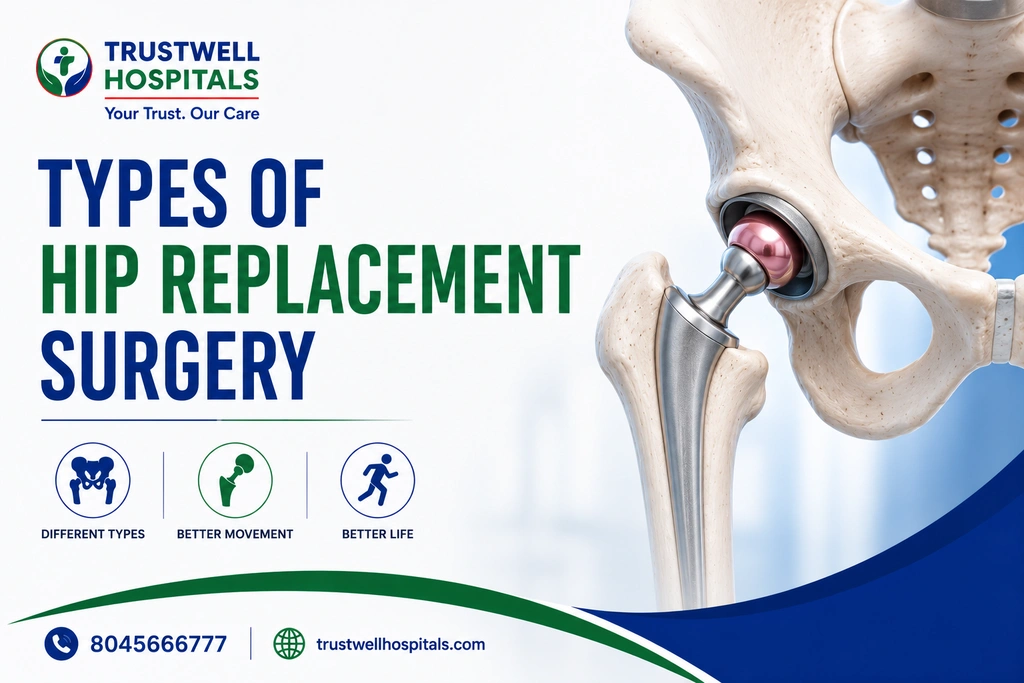
Total Hip Replacement, also known as Total Hip Arthroplasty, is the most commonly performed hip replacement procedure. During surgery, both the damaged ball (femoral head) and the hip socket are replaced with artificial implants to restore smoother joint movement. This procedure is frequently considered for patients with advanced osteoarthritis, rheumatoid arthritis, avascular necrosis, or severe joint degeneration that continues to limit daily activities despite conservative treatment.

Advantages of Total Hip Replacement

✔ Addresses Extensive Joint Damage

Both damaged joint surfaces are replaced, making the procedure suitable for advanced arthritis affecting the entire hip.

✔ Improves Mobility

Many patients experience improved walking ability, better joint movement, and greater comfort during everyday activities following rehabilitation.

✔ Long-Term Treatment Option

Modern hip implants are designed to provide long-term function, although implant longevity varies depending on activity level, body weight, overall health, and rehabilitation.

Partial Hip Replacement

Partial Hip Replacement, sometimes called Hemiarthroplasty, replaces only the damaged femoral head while preserving the natural hip socket. This procedure is more commonly considered for selected hip fractures, particularly when the socket remains healthy and does not require replacement.

Advantages of Partial Hip Replacement

✔ Preserves the Natural Hip Socket

Only the damaged ball portion of the hip joint is replaced, leaving the acetabulum intact when it remains healthy.

✔ Appropriate for Selected Fractures

Certain patients with femoral neck fractures may be suitable candidates depending on fracture pattern, bone quality, and overall health.

✔ Shorter Surgical Reconstruction

Because only one part of the joint is replaced, the procedure involves less joint reconstruction than a total hip replacement.

Robotic-Assisted Hip Replacement

Robotic-Assisted Hip Replacement combines the expertise of the orthopaedic surgeon with advanced computer-guided technology. Before surgery, specialised imaging is used to create a personalised surgical plan based on the patient’s anatomy. During the operation, the robotic platform provides real-time guidance to support accurate implant positioning while the surgeon remains in complete control throughout the procedure.

Advantages of Robotic Hip Replacement

✔ Personalised Surgical Planning

Detailed digital planning allows implant positioning to be tailored to each patient’s individual hip anatomy.

✔ Computer-Guided Precision

The robotic system assists the surgeon with real-time measurements and guidance during implant placement.

✔ Consistent Surgical Execution

Technology-assisted planning helps support accurate implant positioning according to the pre-operative surgical plan.

Revision Hip Replacement

Revision Hip Replacement is performed when an existing artificial hip joint requires replacement or repair. The procedure is generally more complex than a primary hip replacement because the surgeon must first evaluate the condition of the existing implant and surrounding bone. Revision surgery may be considered for implant loosening, wear over time, infection, recurrent hip dislocation, implant fracture, or bone loss around the prosthesis.

Advantages of Revision Hip Replacement

✔ Restores Implant Function

Replacing worn or damaged components may improve hip stability and joint function in appropriately selected patients.

✔ Addresses Implant-Related Problems

Revision surgery allows the surgeon to manage complications such as implant loosening, wear, recurrent instability, or certain infections.

✔ Individualised Surgical Planning

Every revision procedure is planned according to the patient’s previous surgery, implant condition, bone quality, and overall hip health.

Which Type of Hip Replacement Is Right for You?

There is no single hip replacement procedure that is suitable for every patient. The choice depends on the underlying hip condition, the extent of joint damage, bone quality, age, activity level, previous surgeries, and overall health. Your orthopaedic surgeon evaluates these factors before recommending the most appropriate procedure.

Total Hip Replacement May Be Considered When

Advanced Hip Arthritis

Patients with significant cartilage loss affecting both the ball and socket of the hip may be evaluated for total hip replacement.

Hip Pain Affects Everyday Activities

Difficulty walking, climbing stairs, standing for long periods, or performing routine activities despite conservative treatment may influence treatment planning.

Pain Continues During Rest

Persistent discomfort that affects sleep or occurs even while resting may indicate advanced joint degeneration requiring specialist evaluation.

Conservative Treatment No Longer Provides Relief

When medications, physiotherapy, activity modification, and injections no longer adequately control symptoms, surgery may be discussed.

When Is Partial Hip Replacement Considered?

Partial Hip Replacement is generally recommended for selected patients rather than routine hip arthritis. The decision depends on the type of hip damage and the condition of the hip socket.

Partial Hip Replacement May Be Considered When

Certain Hip Fractures

Some femoral neck fractures may be treated with partial hip replacement when the socket remains healthy.

Healthy Hip Socket

If imaging confirms that only the femoral head is damaged while the acetabulum remains unaffected, replacing only the damaged portion of the joint may be appropriate.

Individual Clinical Assessment

Age, bone quality, mobility before injury, and overall medical condition all contribute to deciding whether partial hip replacement is suitable.

When Is Robotic-Assisted Hip Replacement Considered?

Robotic technology is one of several tools available to orthopaedic surgeons. Whether robotic assistance is appropriate depends on clinical evaluation rather than patient preference alone.

Robotic Hip Replacement May Be Considered When

Detailed Surgical Planning Is Beneficial

Computer-assisted planning allows the procedure to be tailored according to the patient’s anatomy before surgery begins.

Precision-Guided Implant Placement Is Preferred

Robotic guidance supports the surgeon with real-time information during bone preparation and implant positioning.

Individual Anatomy Requires Personalised Planning

Patients with anatomical variations or complex joint changes may benefit from additional pre-operative planning depending on the surgeon’s assessment.

When Is Revision Hip Replacement Required?

Revision Hip Replacement is not a routine procedure. It is performed only when an existing artificial hip joint develops problems that require further surgical treatment.

Revision Surgery May Be Considered When

Implant Loosening

Over time, some hip implants may loosen from the surrounding bone, affecting joint stability and function.

Implant Wear

Long-term use may gradually wear certain implant components, particularly in highly active patients.

Infection Around the Implant

Although uncommon, infection involving a hip replacement requires prompt specialist evaluation and may require revision surgery.

Recurrent Hip Dislocation

Repeated instability after hip replacement may require further assessment to determine whether revision surgery is appropriate.

How Do Doctors Choose the Right Type of Hip Replacement?

Selecting the most appropriate procedure involves more than diagnosing hip arthritis. Your orthopaedic surgeon considers multiple clinical factors before recommending surgery.

Underlying Hip Condition

The reason for surgery—such as arthritis, fracture, avascular necrosis, or implant failure—plays a major role in determining the appropriate procedure.

Extent of Joint Damage

Clinical examination and imaging help determine whether only one part of the hip or the entire joint requires treatment.

Bone Quality

Healthy bone provides better support for hip implants and influences surgical planning, particularly in complex or revision procedures.

Age and Overall Health

General fitness, medical conditions, and expected recovery all contribute to selecting the safest and most appropriate treatment.

Lifestyle and Mobility Goals

Daily activities, occupation, exercise habits, and long-term mobility expectations help guide treatment planning.

Previous Hip Surgery

Patients who have undergone previous hip operations may require different surgical planning compared with those having their first hip replacement.
Clinical Consideration Total Hip Replacement Partial Hip Replacement Robotic Hip Replacement Revision Hip Replacement
Advanced Hip Arthritis ✓ Selected Patients
Hip Fracture Selected Cases Selected Cases
Computer-Guided Planning Selected Cases
Previous Hip Implant
Rehabilitation Required
Every patient is different. Your symptoms, imaging findings, hip anatomy, bone quality, overall health, and treatment goals all contribute to choosing the most appropriate procedure. Patients comparing surgical technologies may also find our guides on Robotic vs Traditional Hip Replacement Surgery and Types of Spine Surgery useful for understanding how treatment is tailored to individual conditions.

Call 80 45666777

Why Choose Trustwell Hospitals for Hip Replacement Surgery?

Choosing the right type of hip replacement requires careful evaluation, accurate diagnosis, experienced orthopaedic surgeons, and structured rehabilitation. Trustwell Hospitals offers comprehensive hip care, helping patients receive a personalised treatment plan based on their condition, lifestyle, and long-term mobility goals.

10+ Years of Orthopaedic Experience

With over 10+ years of orthopaedic experience, the department manages hip arthritis, avascular necrosis, fractures, revision joint replacement, and other complex hip disorders using evidence-based treatment approaches.

Thousands of Orthopaedic Patients Treated

The orthopaedic team has successfully treated thousands of patients with hip, knee, shoulder, spine, and sports-related conditions through personalised treatment plans designed around each patient’s needs.

90%+ Patient Satisfaction

More than 90% patient satisfaction reflects the department’s commitment to patient-centred care, transparent communication, and comprehensive rehabilitation.

Expertise in Robotic and Conventional Hip Replacement

Trustwell Hospitals offers both robotic-assisted and conventional hip replacement surgery, enabling treatment recommendations to be based on individual clinical findings rather than a single surgical approach.

Hundreds of Joint Replacement Procedures Performed

The orthopaedic department has performed hundreds of joint replacement procedures, including primary hip replacement, revision joint replacement, and robotic-assisted joint replacement surgeries.

Advanced Diagnostic and Surgical Planning

Digital X-rays, advanced imaging, and detailed pre-operative assessment help determine the most appropriate procedure while supporting personalised surgical planning.

Cashless Insurance Assistance

Dedicated patient coordinators assist with insurance verification, pre-authorisation, documentation, cashless approvals, reimbursement guidance, and discharge formalities.

NABH 6th Edition Certified Hospital

Trustwell Hospitals is NABH 6th Edition Certified and maintains a 4.3 Google Rating, reflecting its commitment to recognised standards of patient safety and quality healthcare. Speak With Our Joint Replacement Specialists

Frequently Asked Questions About Types of Hip Replacement Surgery

Which type of hip replacement is performed most often?

Total Hip Replacement is the most commonly performed procedure for advanced hip arthritis. However, the most appropriate surgery depends on the underlying condition, imaging findings, and your orthopaedic surgeon’s assessment.

Is robotic hip replacement a different operation?

No. Robotic-assisted hip replacement follows the same surgical goal as conventional hip replacement. The difference is that robotic technology provides computer-guided planning and assistance during implant placement.

Can a partial hip replacement later become a total hip replacement?

Yes. In some situations, a previous partial hip replacement may require conversion to a total hip replacement if additional joint damage develops or symptoms progress.

When is revision hip replacement needed?

Revision surgery may be considered when a previous hip implant becomes loose, wears out, becomes infected, fractures, or repeatedly dislocates. Your surgeon determines whether revision surgery is necessary after clinical evaluation.

Do all hip replacement procedures use the same implant?

No. Implant design, size, material, and fixation method vary according to the patient’s anatomy, bone quality, age, and the type of procedure being performed.

Is rehabilitation necessary after every type of hip replacement?

Yes. Physiotherapy and rehabilitation are important after all hip replacement procedures to help restore strength, mobility, balance, and walking ability.

Does every patient with hip arthritis need a total hip replacement?

No. Some patients respond well to non-surgical treatment, while others may require partial hip replacement or different procedures depending on the underlying diagnosis and extent of joint damage.

How does the surgeon decide which procedure is right?

The decision is based on your symptoms, physical examination, X-rays, MRI or CT scans when required, bone quality, overall health, lifestyle, and long-term mobility goals.
Book an Appointment