A New Milestone: Successfully accredited with NABH 6th Edition – Redefining standards in healthcare quality and patient safety | Live vitals. Real-time data. Faster care. Trustwell Hospitals unveils Karnataka’s first 5G SMART ambulance |
Find a Doctor Book Online Appointment
Types of Spine Surgery

Types of Spine Surgery

Types of Spine Surgery

types of spine surgery

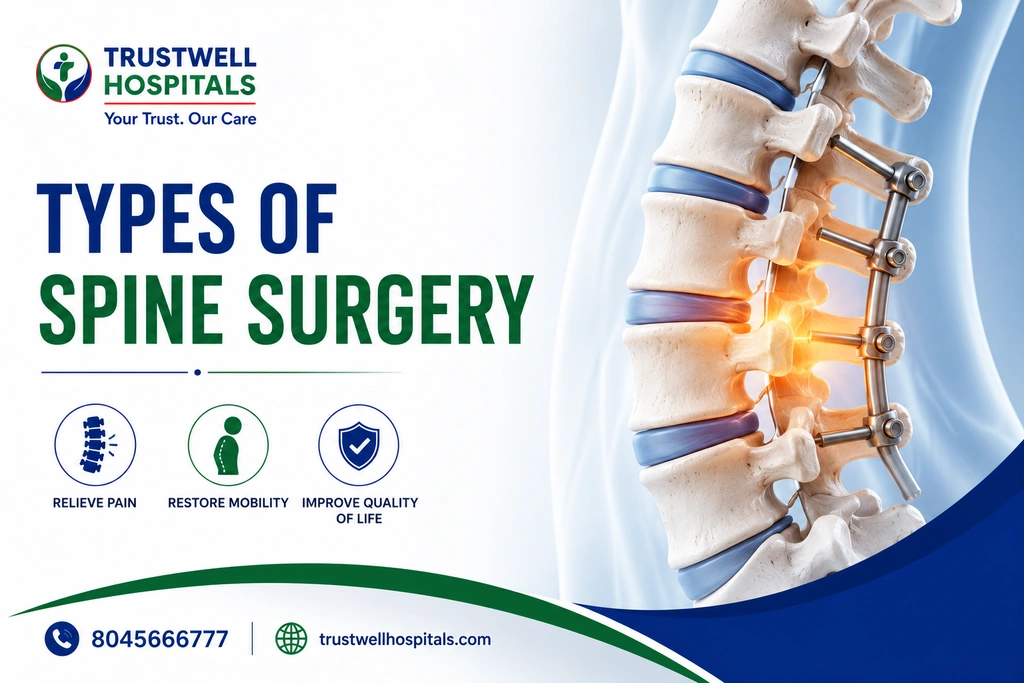
Spine surgery includes several procedures used to treat conditions affecting the neck and back when non-surgical treatments no longer provide adequate relief. The most common types include Discectomy, Laminectomy, Spinal Fusion, Minimally Invasive Spine Surgery, and Artificial Disc Replacement. The most appropriate procedure depends on the underlying spinal condition, the location of the problem, nerve involvement, spinal stability, and the patient’s overall health. Most people with back or neck pain do not require surgery. Many spinal conditions improve with medicines, physiotherapy, lifestyle modifications, or spinal injections. When symptoms persist or nerve compression significantly affects daily life, a spine specialist may discuss whether surgery is appropriate.

Types of Spine Surgery at a Glance

Type of Surgery Primary Purpose Commonly Considered For
Discectomy Removes part of a damaged spinal disc Herniated (slipped) disc causing nerve compression
Laminectomy Removes part of the vertebral bone to relieve pressure Spinal stenosis and nerve compression
Spinal Fusion Joins two or more vertebrae for stability Spinal instability, deformity, or certain degenerative conditions
Minimally Invasive Spine Surgery Treats spinal conditions through smaller incisions Selected disc disorders, spinal stenosis, and nerve compression
Artificial Disc Replacement Replaces a damaged spinal disc while preserving movement Selected patients with symptomatic disc disease
The type of spine surgery recommended depends on clinical examination, imaging studies, and your spine specialist’s evaluation.

Discectomy

Discectomy is a procedure performed to remove the part of a damaged or herniated spinal disc that is pressing on a nearby nerve. By relieving pressure on the affected nerve, the procedure aims to reduce nerve-related symptoms while preserving as much of the healthy disc as possible. Depending on the location of the problem, a discectomy may be performed in the neck (cervical spine) or lower back (lumbar spine).

Advantages of Discectomy

✔ Relieves Nerve Compression

Removing the damaged portion of the disc may reduce pressure on the affected spinal nerve.

✔ Preserves Most of the Disc

Only the part of the disc causing nerve compression is removed whenever appropriate.

✔ May Improve Everyday Function

Reducing nerve irritation may help patients return more comfortably to routine activities following rehabilitation.

Laminectomy

Laminectomy is a decompression procedure that removes part of the vertebral bone, called the lamina, to create additional space around the spinal cord or spinal nerves. It is commonly considered for spinal stenosis, where narrowing of the spinal canal places pressure on important nerve structures.

Advantages of Laminectomy

✔ Creates More Space for Nerves

Removing part of the lamina helps reduce pressure within the spinal canal.

✔ Addresses Spinal Canal Narrowing

The procedure may be appropriate when spinal stenosis contributes to persistent neurological symptoms.

✔ Can Be Combined With Other Procedures

In some situations, laminectomy may be performed together with spinal fusion or other spinal procedures depending on the underlying condition.

Spinal Fusion

Spinal Fusion is performed to permanently join two or more vertebrae, improving spinal stability when excessive movement contributes to pain or neurological symptoms. Bone grafts and specialised implants may be used to support healing while the vertebrae gradually fuse together over time.

Advantages of Spinal Fusion

✔ Improves Spinal Stability

The procedure helps stabilise segments of the spine affected by instability or deformity.

✔ Supports Treatment of Complex Conditions

Fusion may be considered for conditions such as spondylolisthesis, spinal deformity, fractures, or selected degenerative disorders.

✔ Often Combined With Decompression Surgery

When both instability and nerve compression are present, fusion may accompany decompression procedures to provide additional support.

Minimally Invasive Spine Surgery

Minimally Invasive Spine Surgery uses specialised instruments and smaller incisions to access the spine while minimising disruption to surrounding muscles and soft tissues. Not every spinal condition can be treated using minimally invasive techniques. Suitability depends on the location and complexity of the spinal problem.

Advantages of Minimally Invasive Spine Surgery

✔ Smaller Surgical Incisions

Smaller incisions may reduce tissue disruption compared with some conventional open procedures.

✔ Less Muscle Disruption

Specialised techniques aim to preserve surrounding muscles while accessing the affected area of the spine.

✔ Suitable for Selected Conditions

Certain disc problems, nerve compression disorders, and spinal stenosis may be managed using minimally invasive techniques where clinically appropriate.

Artificial Disc Replacement

Artificial Disc Replacement involves removing a damaged spinal disc and replacing it with an artificial disc designed to preserve movement between the affected vertebrae. Unlike spinal fusion, this procedure aims to maintain motion at the treated spinal level. However, it is only suitable for carefully selected patients following detailed clinical and imaging assessment.

Advantages of Artificial Disc Replacement

✔ Preserves Motion at the Treated Level

The artificial disc is designed to maintain movement between adjacent vertebrae rather than permanently joining them.

✔ Alternative to Fusion for Selected Patients

For appropriately selected individuals, artificial disc replacement may provide another surgical option depending on the underlying spinal condition.

✔ Personalised Treatment Selection

The decision depends on the patient’s age, spinal alignment, disc degeneration, overall spinal health, and the surgeon’s assessment.

When Is Each Type of Spine Surgery Considered?

The choice of spine surgery depends on the underlying spinal condition rather than the severity of pain alone. Your spine specialist evaluates your symptoms, neurological examination, MRI findings, spinal stability, and response to non-surgical treatment before recommending a procedure.

When Is Discectomy Considered?

Discectomy is generally considered when a damaged spinal disc compresses a nearby nerve and conservative treatment has not provided sufficient relief.

Herniated (Slipped) Disc

A disc pressing on a spinal nerve may cause persistent arm pain, leg pain, numbness, tingling, or muscle weakness.

Ongoing Nerve Compression

Patients whose nerve-related symptoms continue despite medications, physiotherapy, or activity modification may be evaluated for surgery.

Progressive Weakness

If nerve compression begins affecting muscle strength or limb function, further assessment may determine whether surgical decompression is appropriate.

When Is Laminectomy Considered?

Laminectomy is commonly performed to relieve pressure caused by narrowing of the spinal canal or compression of spinal nerves.

Laminectomy May Be Considered When

Walking Becomes Increasingly Difficult

Spinal stenosis may cause leg pain, heaviness, numbness, or weakness that worsens during walking or prolonged standing.

Reduced Walking Distance

Some patients gradually notice they cannot walk as far as they previously could because nerve compression causes discomfort or weakness.

Persistent Neurological Symptoms

Ongoing numbness, tingling, or weakness related to spinal canal narrowing may require further evaluation.

When Is Spinal Fusion Considered?

Spinal Fusion is recommended only for selected conditions where improving spinal stability is an important part of treatment.

Spinal Fusion May Be Considered When

Spinal Instability

Abnormal movement between vertebrae may contribute to pain, nerve compression, or reduced spinal function.

Spondylolisthesis

When one vertebra slips over another, fusion may be considered to improve stability depending on the severity of the condition.

Spinal Fractures or Deformity

Certain fractures, scoliosis, or other spinal deformities may require fusion as part of surgical treatment.

When Is Minimally Invasive Spine Surgery Considered?

Minimally invasive techniques are appropriate only for selected spinal conditions where the problem can be safely treated through smaller surgical approaches.

Minimally Invasive Surgery May Be Considered When

Localised Disc Disorders

Selected cervical or lumbar disc problems may be suitable for minimally invasive surgery after careful imaging assessment.

Certain Cases of Spinal Stenosis

Some patients with nerve compression caused by spinal narrowing may benefit from minimally invasive decompression procedures.

Appropriate Anatomy for Smaller Surgical Access

The location and complexity of the spinal condition determine whether minimally invasive techniques can be safely performed.

When Is Artificial Disc Replacement Considered?

Artificial Disc Replacement is suitable only for carefully selected patients and is not appropriate for every spinal condition.

Artificial Disc Replacement May Be Considered When

Degeneration Limited to One Disc

Patients with isolated disc degeneration and preserved spinal stability may be evaluated for this procedure.

Motion Preservation Is Appropriate

Unlike spinal fusion, artificial disc replacement is designed to maintain movement at the treated spinal level in selected cases.

Clinical Assessment Supports the Procedure

Overall spinal alignment, age, bone quality, neurological findings, and imaging studies all influence patient selection.

How Do Doctors Choose the Right Type of Spine Surgery?

Every spinal condition is different. Your spine specialist combines clinical findings with imaging results to determine which procedure, if any, is most appropriate.

Underlying Spinal Condition

The diagnosis—such as a herniated disc, spinal stenosis, spondylolisthesis, spinal fracture, or degenerative disc disease—is the most important factor guiding treatment.

Location of the Problem

Whether the condition affects the cervical, thoracic, or lumbar spine influences both the surgical approach and the type of procedure recommended.

Degree of Nerve Compression

Persistent nerve pressure causing pain, numbness, tingling, or muscle weakness may require different treatment than spinal instability alone.

Spinal Stability

Conditions affecting spinal alignment or excessive movement between vertebrae may require stabilisation procedures in addition to decompression.

General Health

Age, bone quality, existing medical conditions, previous spine surgery, and overall fitness all contribute to surgical planning.

Functional Goals

Occupation, daily activities, mobility requirements, and personal recovery goals help guide the final treatment recommendation.
Clinical Consideration Discectomy Laminectomy Spinal Fusion Minimally Invasive Surgery Artificial Disc Replacement
Herniated Disc Selected Cases ✓ Selected Cases Selected Cases
Spinal Stenosis Selected Cases Selected Cases ✓ Selected Cases
Spinal Instability Selected Cases
Motion Preservation
Rehabilitation Required
Every patient requires an individualised treatment plan. Clinical examination, MRI findings, neurological assessment, spinal stability, and overall health all help determine the most appropriate surgical approach. Patients comparing surgical options may also find information on Spine Surgery Symptoms, Sciatica Treatment, and Types of Hip Replacement Surgery helpful for understanding related conditions and treatment pathways.

Why Choose Trustwell Hospitals for Spine Surgery?

Choosing the right spine procedure requires accurate diagnosis, experienced spine specialists, advanced imaging, and personalised treatment planning. Trustwell Hospitals provides comprehensive spine care, offering both non-surgical and surgical treatment options based on each patient’s condition, neurological findings, and long-term recovery goals.

10+ Years of Orthopaedic Experience

With over 10+ years of orthopaedic experience, the department manages slipped discs, spinal stenosis, sciatica, spinal fractures, degenerative spine disorders, and complex spinal conditions using evidence-based treatment approaches.

Thousands of Orthopaedic Patients Treated

The orthopaedic team has successfully treated thousands of patients with spine, joint, sports injury, fracture, and musculoskeletal conditions through personalised treatment plans.

90%+ Patient Satisfaction

More than 90% patient satisfaction reflects the department’s commitment to personalised care, clear communication, and comprehensive rehabilitation throughout recovery.

Advanced Spine Evaluation

Comprehensive neurological assessment, digital X-rays, MRI, CT scans, and detailed clinical examination help accurately diagnose spinal conditions and determine the most appropriate treatment.

Expertise in Minimally Invasive and Complex Spine Procedures

The spine team performs a range of procedures, including decompression surgery, spinal fusion, minimally invasive spine surgery, and treatment for nerve compression disorders, depending on the patient’s diagnosis and surgical requirements.

Hundreds of Complex Orthopaedic Procedures Performed

The department has performed hundreds of complex orthopaedic procedures, including spine surgery, joint replacement, fracture fixation, arthroscopy, and trauma surgery.

Cashless Insurance Assistance

Dedicated patient coordinators assist with insurance verification, pre-authorisation, documentation, cashless approvals, reimbursement guidance, and discharge formalities.

NABH 6th Edition Certified Hospital

Trustwell Hospitals is NABH 6th Edition Certified and maintains a 4.3 Google Rating, reflecting its commitment to recognised standards of patient safety and quality healthcare. Call 80 45666777

Frequently Asked Questions About Types of Spine Surgery

Which spine surgery is performed most often?

The most appropriate spine procedure depends on the diagnosis. Discectomy, laminectomy, spinal fusion, and minimally invasive spine surgery are commonly performed for different spinal conditions.

Is minimally invasive spine surgery suitable for everyone?

No. Minimally invasive techniques are appropriate only for selected spinal conditions. Your spine specialist determines suitability after reviewing your MRI scans, symptoms, and overall spinal health.

What is the difference between discectomy and laminectomy?

Discectomy removes part of a damaged spinal disc pressing on a nerve, while laminectomy removes part of the vertebral bone to relieve pressure caused by spinal canal narrowing.

When is spinal fusion necessary?

Spinal fusion may be recommended when spinal instability, spondylolisthesis, deformity, fractures, or certain degenerative conditions require additional stability.

Does artificial disc replacement replace the entire spine?

No. Artificial disc replacement only replaces a damaged spinal disc at a selected spinal level while aiming to preserve movement between the affected vertebrae.

Will I need physiotherapy after spine surgery?

Yes. Rehabilitation is an important part of recovery after most spine procedures and helps improve mobility, strength, flexibility, posture, and overall function.

How does the surgeon decide which spine surgery is appropriate?

The decision is based on your symptoms, neurological examination, MRI findings, spinal stability, overall health, response to conservative treatment, and personal recovery goals.

Can spine surgery completely eliminate back pain?

The goal of spine surgery is to treat the underlying spinal condition causing symptoms. Recovery varies for every patient and depends on the diagnosis, procedure performed, rehabilitation, and individual healing.
Book an Appointment