


 Neuro Sciences
 Gastro Sciences
 Kidney Diseases
 Orthopedics
 Transplantation
 ENT and Head-Neck Surgery
 Advanced Trauma Center
 Cardiology
 Interventional Pulmonology
 Hematology and Bone Marrow Transplant(BMT)
 Anesthesia
 Critical Care Excellence: Comprehensive Intensive Care Services in Bangalore
 Dental Surgery and Oral Implants
 Dermatology and Cosmetic Surgery
 Endocrinology and Diabetology
 Facial Plastic and Reconstructive Surgery
 Family Medicine
 Internal Medicine
 Microbiology
 Obstetrics and Gynaecology
 Oncology
 Ophthalmology
 Oral and Maxillofacial Surgery
 Pathology and Laboratory
 Pediatrics
Hernia Surgery Types: Open vs Laparoscopic Hernia Surgery and Other Treatment Options
When Is Hernia Surgery Needed?
Unlike muscle strains, hernias do not heal naturally because the weakness in the abdominal wall remains present. Although some small, minimally symptomatic hernias may be monitored, surgery is generally recommended for patients with persistent symptoms or an increased risk of complications. Doctors commonly recommend surgery if you experience:- Persistent pain or discomfort
- A growing bulge in the abdomen or groin
- Difficulty performing daily activities
- Recurrent hernia symptoms
- Incarcerated or strangulated hernia
- Cosmetic concerns caused by a large hernia
Common Types of Hernia Surgery
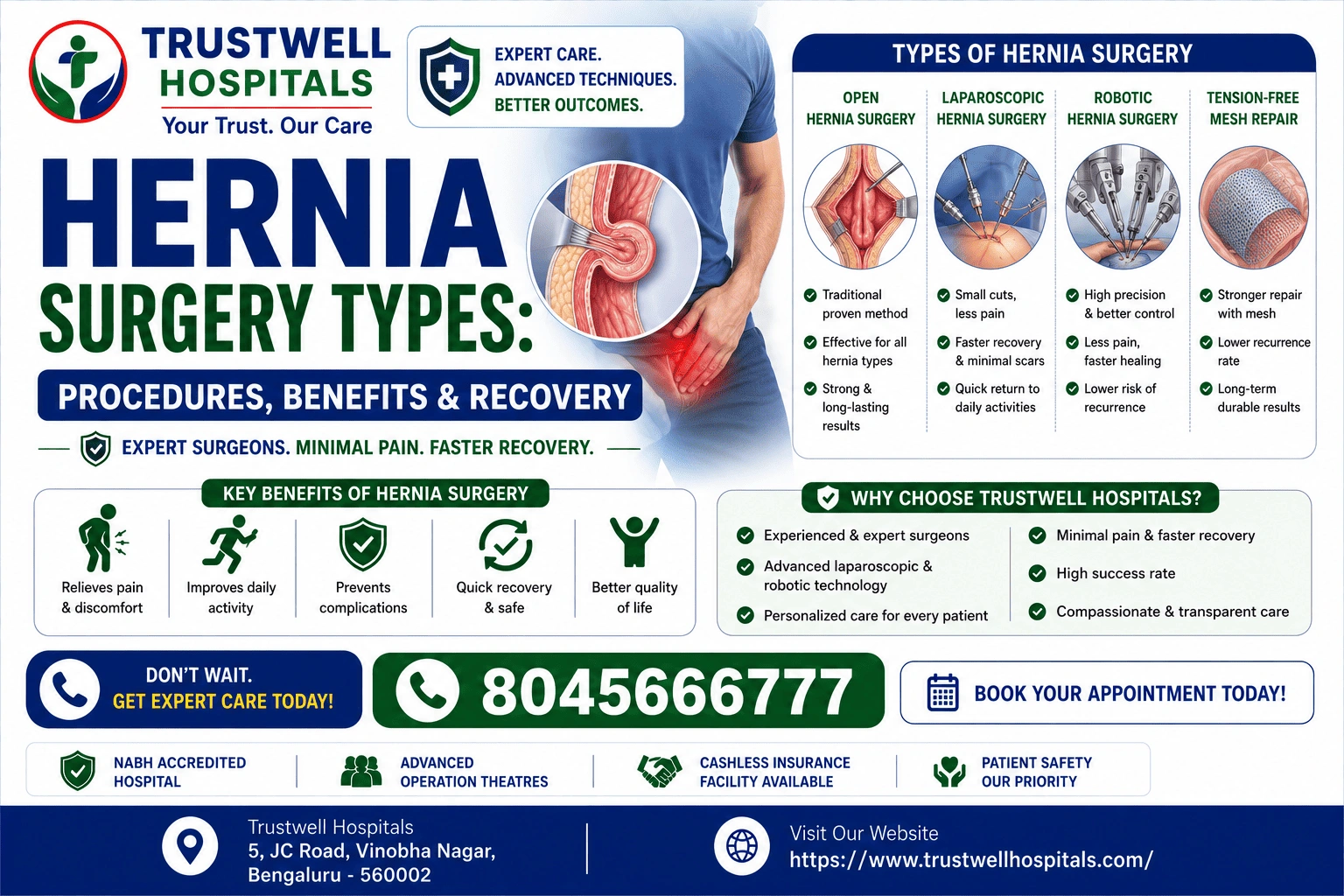
Several surgical techniques are available to repair hernias. The choice depends on the type and location of the hernia, the patient’s health, and whether it is a first-time or recurrent hernia. The primary surgical approaches include:- Open hernia repair
- Laparoscopic hernia repair
- Robotic-assisted hernia repair
- Emergency hernia surgery
Comparison of Hernia Surgery Types
Choosing the right hernia surgery depends on several factors, including the size and location of the hernia, your overall health, previous surgeries, and your surgeon’s recommendation. The table below highlights the key differences between the most common surgical approaches.
| Feature | Open Hernia Repair | Laparoscopic Hernia Repair | Robotic-Assisted Hernia Repair |
|---|---|---|---|
| Incision Size | Single larger incision | Several small incisions | Several small robotic-assisted incisions |
| Surgical Technique | Direct repair through an open incision | Minimally invasive repair using a camera and specialized instruments | Minimally invasive repair using robotic technology |
| Postoperative Pain | Usually more discomfort | Generally less discomfort | Often less discomfort in selected patients |
| Hospital Stay | May be slightly longer depending on the procedure | Usually shorter | Usually comparable to laparoscopic surgery |
| Recovery Time | Longer recovery for many patients | Faster return to daily activities | Faster recovery in appropriately selected patients |
| Best Suited For | Large, complex, or some recurrent hernias | Many uncomplicated abdominal wall hernias | Selected patients requiring advanced minimally invasive surgery |
| Mesh Use | Commonly used | Commonly used | Commonly used |
Open Hernia Repair
Open hernia repair is one of the most established and widely performed surgical techniques. During this procedure, the surgeon makes an incision directly over the hernia, returns the protruding tissue to its normal position, and repairs the weakened abdominal wall. In most cases, a surgical mesh is placed to strengthen the repair and reduce the risk of recurrence.Advantages of Open Hernia Repair
Open surgery may be recommended because it:- Is suitable for many types of hernias
- Can be performed under local, spinal, or general anesthesia in selected cases
- Is effective for large or complex hernias
- Is often preferred for certain recurrent hernias
- Has a long history of successful outcomes
Laparoscopic Hernia Repair
Laparoscopic hernia repair is a minimally invasive procedure performed through several small incisions using a camera and specialized surgical instruments. Instead of making a large incision, the surgeon repairs the weakened area from inside the abdominal cavity using mesh reinforcement. Many patients choose Laparoscopic Hernia Surgery in Bangalore because it combines effective repair with faster recovery and less postoperative discomfort.Benefits of Laparoscopic Hernia Surgery
Compared with conventional open surgery, laparoscopic repair may offer:- Smaller incisions
- Less postoperative pain
- Reduced blood loss
- Lower risk of wound infection
- Shorter hospital stay
- Faster return to work
- Better cosmetic results
Robotic-Assisted Hernia Surgery
Robotic-assisted hernia repair is an advanced minimally invasive technique that uses robotic technology to enhance surgical precision. The surgeon controls robotic instruments from a console, allowing highly accurate movements during the procedure. Potential benefits include:- Enhanced visualization
- Greater surgical precision
- Smaller incisions
- Reduced postoperative discomfort
- Faster recovery in selected patients
Mesh Repair vs Non-Mesh Repair
One of the most common questions patients ask is whether surgical mesh is always required.Mesh Repair
In modern hernia surgery, mesh repair is commonly performed because it reinforces the weakened abdominal wall and significantly reduces the likelihood of recurrence. Benefits include:- Stronger repair
- Lower recurrence rates
- Suitable for most adult hernias
- Better long-term durability
Non-Mesh Repair
In carefully selected cases, surgeons may perform a tissue-based repair without mesh. This approach may be considered for:- Very small hernias
- Selected young patients
- Patients with specific medical considerations
- Situations where mesh placement is not advisable
How Do Doctors Choose the Right Hernia Surgery?
Several factors influence the choice of surgical technique. These include:- Type of hernia
- Size of the hernia
- Whether the hernia is recurrent
- Patient’s age
- Overall health
- Previous abdominal surgeries
- Presence of complications
- Lifestyle and occupation
Emergency Hernia Surgery
While many hernia repairs are planned elective procedures, some situations require immediate surgery. An incarcerated or strangulated hernia can cut off the blood supply to the trapped intestine or tissue, making emergency treatment essential. Seek urgent medical attention if you experience:- Sudden, severe pain at the hernia site
- A bulge that cannot be pushed back
- Redness or discoloration over the swelling
- Fever
- Nausea and vomiting
- Abdominal bloating
- Inability to pass stools or gas
Recovery After Hernia Surgery
Recovery varies depending on the type of surgery performed, the size of the hernia, and the patient’s overall health. Most patients can expect:- Walking within a few hours after surgery
- Gradual return to light daily activities
- Pain that improves over several days
- A return to office-based work within a short period, depending on the procedure and medical advice
- Temporary restrictions on heavy lifting and strenuous exercise
Possible Risks and Complications
Hernia surgery is generally safe, especially when performed by experienced surgeons. However, as with any operation, certain risks are possible. Potential complications include:- Bleeding
- Infection
- Seroma (fluid collection)
- Chronic pain
- Mesh-related complications
- Hernia recurrence
- Injury to nearby structures (rare)
How to Reduce the Risk of Hernia Recurrence
Although surgery repairs the weakened abdominal wall, adopting healthy lifestyle habits can help lower the risk of recurrence. Doctors commonly recommend:- Maintaining a healthy body weight
- Eating a fiber-rich diet to prevent constipation
- Avoiding smoking
- Using proper lifting techniques
- Treating chronic cough promptly
- Following activity restrictions during recovery
- Gradually returning to exercise under medical guidance

