


 Neuro Sciences
 Gastro Sciences
 Kidney Diseases
 Orthopedics
 Transplantation
 ENT and Head-Neck Surgery
 Advanced Trauma Center
 Cardiology
 Interventional Pulmonology
 Hematology and Bone Marrow Transplant(BMT)
 Anesthesia
 Critical Care Excellence: Comprehensive Intensive Care Services in Bangalore
 Dental Surgery and Oral Implants
 Dermatology and Cosmetic Surgery
 Endocrinology and Diabetology
 Facial Plastic and Reconstructive Surgery
 Family Medicine
 Internal Medicine
 Microbiology
 Obstetrics and Gynaecology
 Oncology
 Ophthalmology
 Oral and Maxillofacial Surgery
 Pathology and Laboratory
 Pediatrics
Piles Surgery Types: A Complete Guide to Choosing the Right Procedure
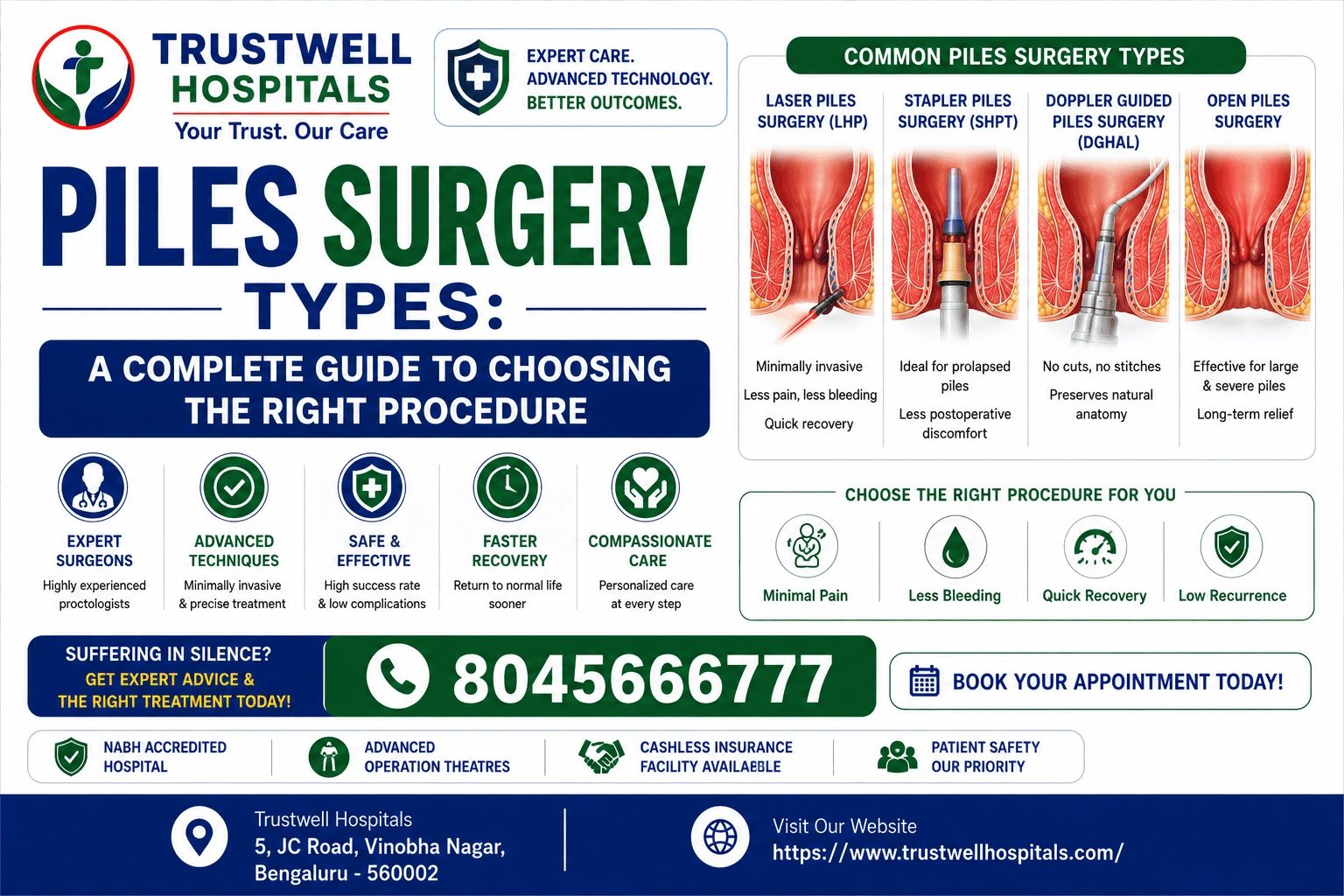
Piles, also known as hemorrhoids, are swollen veins in the lower rectum or anus that can cause discomfort, itching, bleeding, and pain during bowel movements. While many people find relief through dietary changes, medications, and lifestyle modifications, surgery may become the most effective solution when symptoms are severe, recurrent, or do not improve with conservative treatment.
Fortunately, advances in surgical techniques have made piles treatment much safer and more comfortable than in the past. Today, several minimally invasive procedures are available alongside traditional surgery, allowing doctors to choose the most appropriate option based on the severity of the condition and the patient’s overall health.
This guide explains the different types of piles surgery, who may need surgery, the benefits and limitations of each procedure, and what to expect during recovery.
Generally, higher-grade hemorrhoids are less likely to respond to medications alone and often benefit from surgical intervention.
What Are Piles?
Piles are enlarged blood vessels that develop in or around the anal canal due to increased pressure. They may occur internally inside the rectum or externally around the anus. Several factors increase the risk of developing piles, including:- Chronic constipation
- Frequent straining during bowel movements
- Low-fiber diet
- Obesity
- Pregnancy
- Sitting for prolonged periods
- Chronic diarrhea
- Increasing age
When Is Piles Surgery Recommended?
Most early-stage hemorrhoids can be managed successfully with dietary improvements, increased fluid intake, stool softeners, and medications. However, surgery becomes a better option when conservative treatment no longer provides lasting relief. Your doctor may recommend surgery if you have:- Persistent or recurrent rectal bleeding
- Large prolapsing hemorrhoids
- Grade III or Grade IV piles
- Severe pain affecting daily activities
- Recurrent thrombosed external hemorrhoids
- Frequent recurrence after non-surgical treatment
- Difficulty maintaining hygiene because of prolapsed piles
Understanding the Grades of Piles
The severity of piles (hemorrhoids) is classified into four grades based on how much the swollen hemorrhoidal tissue protrudes from the anus and whether it can return to its normal position. Determining the grade of piles helps colorectal surgeons recommend the most effective treatment, ranging from lifestyle modifications and medications to minimally invasive procedures or surgery.
| Grade | What It Means | Common Symptoms | Treatment |
|---|---|---|---|
| Grade I | The piles stay inside the anus and do not come out. | Mild bleeding during bowel movements, itching, irritation, or slight discomfort. | High-fibre diet, drinking more water, medications, and lifestyle changes. |
| Grade II | The piles come out during bowel movements but go back inside on their own. | Bleeding, itching, mucus discharge, and a feeling that the bowel has not emptied completely. | Medications, lifestyle changes, or minimally invasive procedures if symptoms continue. |
| Grade III | The piles come out during bowel movements and need to be pushed back inside by hand. | Pain, swelling, itching, bleeding, mucus discharge, and discomfort. | Minimally invasive procedures or surgery, depending on the severity of symptoms. |
| Grade IV | The piles remain outside the anus all the time and cannot be pushed back. | Severe pain, swelling, bleeding, difficulty maintaining hygiene, and risk of blood clots or tissue damage. | Surgery is usually required, such as laser piles surgery, stapled hemorrhoidopexy, or hemorrhoidectomy. |
Types of Piles Surgery
Several surgical techniques are available today. Each procedure has specific advantages depending on the patient’s condition, symptoms, and expectations.1. Conventional Hemorrhoidectomy
Hemorrhoidectomy is one of the most effective procedures for treating advanced hemorrhoids. During this surgery, the surgeon completely removes the enlarged hemorrhoidal tissue. It is commonly recommended for:- Large Grade III hemorrhoids
- Grade IV hemorrhoids
- Multiple hemorrhoids
- Recurrent piles
- Large external hemorrhoids
2. Stapled Hemorrhoidopexy
Stapled hemorrhoidopexy, also known as stapler surgery, is a minimally invasive alternative for treating prolapsing internal hemorrhoids. Instead of removing the hemorrhoids, the procedure lifts the prolapsed tissue back into its normal position while reducing its blood supply. Over time, the hemorrhoids shrink naturally. Stapler surgery is generally recommended for:- Grade III hemorrhoids
- Selected Grade IV internal hemorrhoids
- Patients with prolapsing internal piles
- Less postoperative pain
- Faster recovery
- Shorter hospital stay
- Earlier return to normal activities
3. Laser Piles Surgery
Laser piles surgery has become increasingly popular because it offers a minimally invasive approach with reduced tissue damage. During the procedure, a laser energy source precisely shrinks the hemorrhoidal tissue while sealing nearby blood vessels, minimizing bleeding. Laser surgery is commonly recommended for:- Grade II hemorrhoids
- Grade III hemorrhoids
- Patients seeking faster recovery
- Individuals suitable for minimally invasive treatment
- Minimal bleeding
- Less postoperative discomfort
- Faster healing
- Smaller wounds
- Short hospital stay
- Early return to work
4. Doppler-Guided Hemorrhoidal Artery Ligation (HAL-RAR)
Doppler-guided hemorrhoidal artery ligation, commonly called HAL-RAR, is another minimally invasive procedure that treats hemorrhoids by targeting their blood supply. Using a Doppler ultrasound device, the surgeon identifies the arteries supplying blood to the hemorrhoids and ties them off. Reduced blood flow causes the hemorrhoids to shrink gradually while preserving the surrounding tissue. This procedure is generally recommended for:- Grade II hemorrhoids
- Grade III hemorrhoids
- Patients with persistent bleeding
- Individuals who prefer less invasive treatment with quicker recovery
5. Rubber Band Ligation
Rubber band ligation is one of the most commonly performed outpatient procedures for treating early-stage internal hemorrhoids. Although it is not considered major surgery, it is an effective minimally invasive treatment for selected patients. During the procedure, the surgeon places a small rubber band around the base of the hemorrhoid. This cuts off its blood supply, causing the hemorrhoid to shrink and eventually fall off within a few days. Rubber band ligation is generally recommended for:- Grade I hemorrhoids
- Grade II hemorrhoids
- Selected Grade III hemorrhoids
- No surgical incision
- Quick outpatient procedure
- Minimal recovery time
- Low complication rate
- Return to normal activities within a day or two
6. Sclerotherapy
Sclerotherapy is another minimally invasive treatment used primarily for small internal hemorrhoids. During this procedure, a special solution is injected into the hemorrhoidal tissue, causing it to shrink over time. Doctors usually recommend sclerotherapy for patients who have:- Grade I hemorrhoids
- Small Grade II hemorrhoids
- Mild bleeding without significant prolapse
- Medical conditions that make major surgery less suitable
7. Infrared Coagulation
Infrared coagulation uses controlled infrared heat to shrink hemorrhoidal tissue by sealing the blood vessels supplying it. It is most effective for:- Grade I hemorrhoids
- Small Grade II hemorrhoids
- Minimal discomfort
- No surgical cuts
- Quick recovery
- Short treatment time
Which Type of Piles Surgery Is Best?
There is no single procedure that is ideal for every patient. The most suitable surgery depends on several clinical factors, including:- Grade of hemorrhoids
- Internal or external piles
- Size of the hemorrhoids
- Severity of symptoms
- Amount of bleeding
- Previous treatments
- Overall health
- Recovery expectations
Recovery After Piles Surgery
Recovery varies depending on the procedure performed. Most minimally invasive treatments allow patients to resume routine activities within a few days, whereas conventional hemorrhoidectomy may require several weeks for complete healing. To support faster recovery, doctors generally recommend:- Eating a high-fiber diet
- Drinking adequate water throughout the day
- Avoiding constipation and excessive straining
- Taking prescribed medications as directed
- Walking regularly to improve circulation
- Maintaining proper anal hygiene
- Avoiding heavy lifting during recovery
- Attending follow-up appointments
Are There Any Risks?
Modern piles surgery is considered safe when performed by experienced specialists. Like any surgical procedure, however, there are potential risks. These may include:- Temporary pain
- Mild bleeding
- Infection
- Difficulty passing urine
- Temporary constipation
- Swelling
- Rare narrowing of the anal canal
- Recurrence in some patients
Can Piles Return After Surgery?
Although surgery offers long-term relief for most patients, hemorrhoids can recur if the underlying causes are not addressed. Common reasons for recurrence include:- Chronic constipation
- Low-fiber diet
- Obesity
- Prolonged sitting
- Frequent straining during bowel movements
- Lack of physical activity
Conditions That Can Be Mistaken for Piles
Not every case of rectal bleeding or anal pain is caused by hemorrhoids. Several other conditions produce similar symptoms and require different treatments. These include:- Anal fissures
- Anal fistulas
- Colon polyps
- Inflammatory bowel disease
- Colorectal cancer
When Should You Consult a Specialist?
You should seek medical evaluation if you experience:- Persistent rectal bleeding
- Severe anal pain
- A lump around the anus that does not improve
- Recurrent hemorrhoids
- Difficulty passing stools
- Pus discharge
- Fever associated with anal swelling
- Blood mixed with stools
- Unexplained weight loss

